

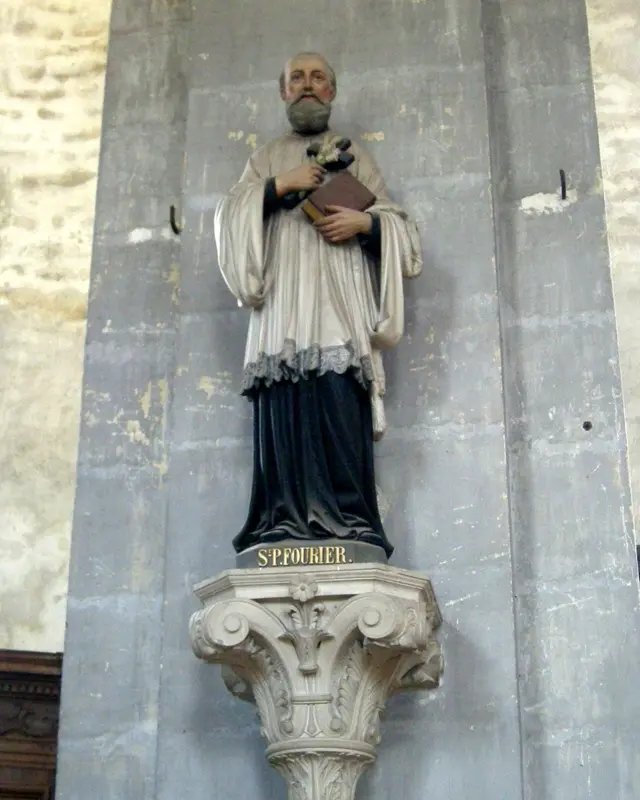
Saint Peter Fourier
Parish priest of Mattaincourt who founded a congregation to teach poor girls
- Rank
- Saint
- Kind
- Priest, Founder
- Life
- 1565 – 1640
- Era
- 17th century
- Feast
- 9 December
- Countries
- France
Life story
Peter Fourier was born on 30 November 1565 at Mirecourt in Lorraine. From the age of fifteen he studied at the University of Pont-à-Mousson and then became a canon regular at the abbey of Chaumousey. He was ordained a priest at Trier on 24 February 1589.
In 1597 he accepted the parish of Mattaincourt, a district described as corrupt and threatened by Protestantism, and stayed there about twenty years. He set up a mutual aid fund for poor parishioners and three sodalities: of Saint Sebastian for men, of the Holy Rosary for women, and of the Immaculate Conception for girls. He was known as “the good father of Mattaincourt.”
Around 1597-1598, with Alix Le Clerc, he founded the Congregation of Notre Dame, a community of women who taught poor girls free of charge. In 1621, at the direction of the Bishop of Toul, he reformed the canons regular of Lorraine. They were formed into the Congregation of Our Saviour between about 1625 and 1629, and he was elected its superior general in 1632.
Because of his loyalty to the House of Lorraine he was driven into exile. In 1636 he and his community left their abbey for Gray, in Burgundy. He died on 9 December 1640 at Gray, aged seventy-five, while nursing plague victims. Pope Benedict XIII beatified him in 1730 and Pope Leo XIII canonized him in 1897.
Works and witness
- Ordained in 1589; canon regular at Chaumousey
- Parish priest of Mattaincourt from 1597; set up a mutual aid fund and sodalities
- With Alix Le Clerc founded the Congregation of Notre Dame to teach girls free of charge
- Reformed the canons regular of Lorraine and became superior general in 1632
- Died at Gray on 9 December 1640; canonized in 1897
Saints from the same country
References
- Catholic Encyclopedia (1911), entry St. Peter Fourier (New Advent, cathen/11767b)
Written by Anawim from documented history. Some details about ancient saints rest on tradition and are marked as such.