

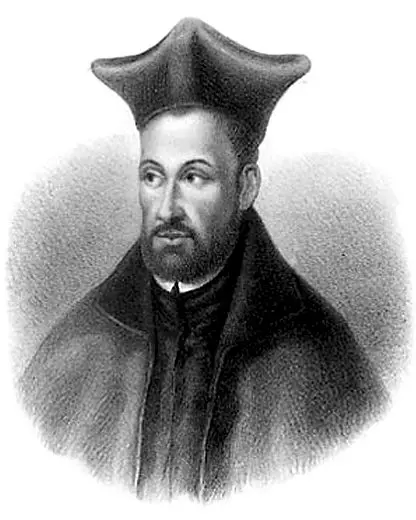
Saint Peter Faber
Roommate of Ignatius and Francis Xavier and the first priest of the Jesuits
- Rank
- Saint
- Kind
- Priest, Religious, Founder
- Life
- 1506 – 1546
- Era
- 16th century
- Feast
- 2 August
- Countries
- France, Germany, Italy
Life story
Peter Faber, also spelled Favre, was born on 13 April 1506 in Villaret, in Savoy, into a farming family. As a boy he looked after sheep, but he showed a talent for study and was sent to school. He went to Paris and entered the Collège Sainte-Barbe, where he shared a room with Francis Xavier and met Ignatius of Loyola.
Along with Ignatius, Xavier and a few other fellow students, he was one of the founding group of the Jesuits. He was the first of the group to be ordained a priest, and in 1534 he celebrated Mass on Montmartre, where his companions made their vows together. Afterwards he worked in Rome and was then sent to many places.
From 1540 he worked in Germany, where he took part in the religious colloquies at Worms and Regensburg, and then in Speyer, Mainz and Cologne. In Cologne he met and guided several young men, among them Peter Canisius, who later became a leading Jesuit in Germany. He was also sent to Spain and Portugal on business for the order.
He was invited to attend the Council of Trent, but arrived in Rome feverish and died on 1 August 1546 at the age of forty. He was beatified in 1872, and Pope Francis extended his veneration to the whole Church as a saint on 17 December 2013. His feast is kept on 2 August.
Works and witness
- Shared a room with Francis Xavier and Ignatius of Loyola at Sainte-Barbe in Paris
- First priest of the founding group of the Jesuits
- Worked in Germany from 1540, including Worms, Regensburg, Speyer and Cologne
- Guided Peter Canisius in Cologne
- Died in Rome on 1 August 1546
Saints from the same country
References
- Martyrologium Romanum
- Dicastery for the Causes of Saints – biographical profile
- Vatican News, profile of Saint Peter Faber
Written by Anawim from documented history. Some details about ancient saints rest on tradition and are marked as such.