

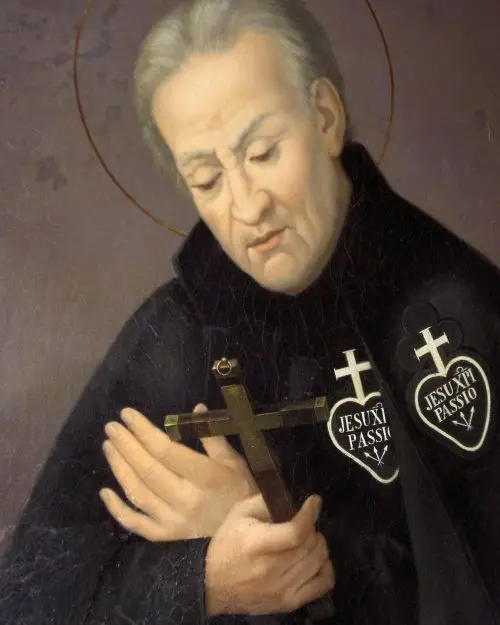
Saint Paul of the Cross
Founder of the Passionists, who called people to remember the Passion of Christ
- Rank
- Saint
- Kind
- Priest, Founder, Mystic
- Life
- 1694 – 1775
- Era
- 18th century
- Feast
- 20 October
- Countries
- Italy
Life story
Paul Francis Danei was born on 3 January 1694 at Ovada in Piedmont, Italy, into a large family of small traders. He grew up in a household with modest means, helping his father in business, and according to the records had a deep life of prayer from his youth. In 1717 he volunteered for a campaign against the Turks but stayed in the army only briefly.
In 1720, at Castellazzo, he put on a black habit and began writing a rule for a group living a life of prayer centred on remembering the Passion of Jesus. With his brother John Baptist, who also became a priest, he founded the first retreat of the group on Monte Argentario in 1737. He was ordained a priest in 1727 and travelled preaching many missions. In 1747 he was elected the first superior general of the congregation, and his surviving letters show him guiding many individuals, lay and religious alike.
The Congregation of the Passion had its rule approved by Pope Benedict XIV in 1741 and further confirmed under Clement XIV in 1769. In 1771 he founded a convent for women at Corneto, now Tarquinia. The members lived poorly, prayed and preached, aiming especially at country people and the poor.
He died on 18 October 1775 in Rome, in the monastery of Saints John and Paul on the Caelian Hill. He was beatified in 1852 and canonised in 1867 under Pope Pius IX.
Works and witness
- Volunteered for the campaign against the Turks in 1717
- Began writing the rule of the future Passionists in 1720
- Founded the first retreat on Monte Argentario in 1737
- Rule approved by Pope Benedict XIV in 1741
- Canonised in 1867
Saints from the same country
References
- Martyrologium Romanum
- Dicastery for the Causes of Saints – biographical profile
- Paul of the Cross, Lettere (collected letters)
Written by Anawim from documented history. Some details about ancient saints rest on tradition and are marked as such.