

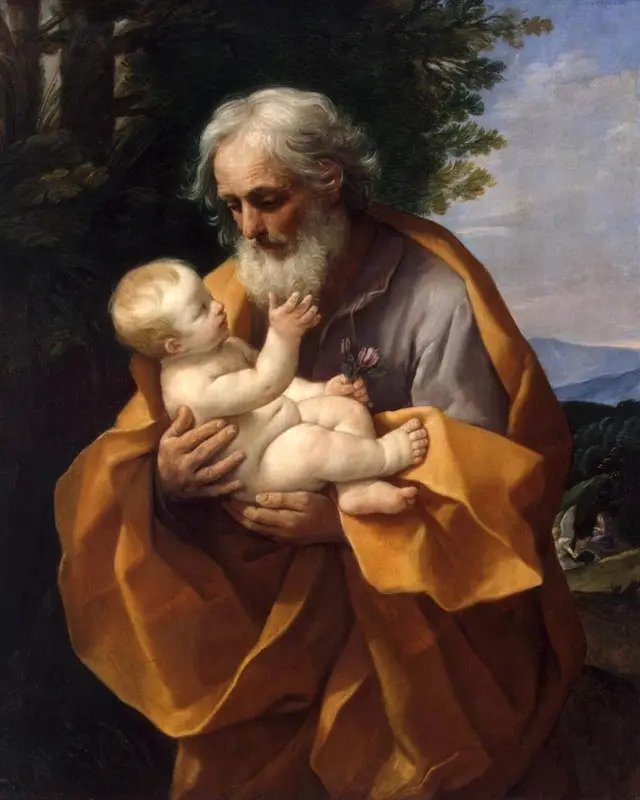
Saint Joseph
The craftsman of Nazareth, husband of Mary and foster father of Jesus
- Rank
- Saint
- Kind
- Layperson
- Feast
- 19 March
- Countries
- Israel, Egypt
Life story
The Gospels of Matthew and Luke describe Joseph as a descendant of King David living in Nazareth in Galilee. Matthew calls him a righteous man and says his trade was that of a tekton, a Greek word usually translated as carpenter or craftsman. He was betrothed to Mary. The Gospel of Luke recounts that he took her to Bethlehem for a census, and both Matthew and Luke place the birth of Jesus there.
Matthew tells that he took Mary and the child to Egypt to escape King Herod, then returned and settled in Nazareth after Herod's death. Luke recounts the family's yearly pilgrimage to Jerusalem for Passover and their finding the twelve-year-old Jesus in the Temple. That is his last appearance in the Gospels, and none of his words are recorded.
No surviving text says anything about his death. It is often assumed that he died before Jesus began his public ministry, since he is not mentioned afterwards, but this is only inference. Devotion to him grew strongly from the Middle Ages onward. In 1870 Pope Pius IX declared him Patron of the Universal Church, and in 1955 Pope Pius XII established the feast of St Joseph the Worker. The Church marks his main feast on 19 March, and he appears in art almost always with the child Jesus or with the tools of his trade. Because the sources are so brief, later centuries filled the gap with stories in apocryphal writings, which historians do not treat as reliable evidence about his real life.
Works and witness
- Of David's line, lived in Nazareth and worked as a craftsman
- Took Mary to Bethlehem, where Jesus was born
- Took the family to Egypt to escape Herod, then to Nazareth, per Matthew
- Went on yearly pilgrimage with the family to Jerusalem, per Luke
- Declared Patron of the Universal Church by Pius IX in 1870
Patron of
Universal Church, Workers, Fathers
Saints from the same country
References
- Tân Ước: Tin Mừng Matthêu và Luca (New Testament: Matthew and Luke)
- Martyrologium Romanum
- Redemptoris Custos (Tông huấn của Đức Gioan Phaolô II, 1989)
Written by Anawim from documented history. Some details about ancient saints rest on tradition and are marked as such.