

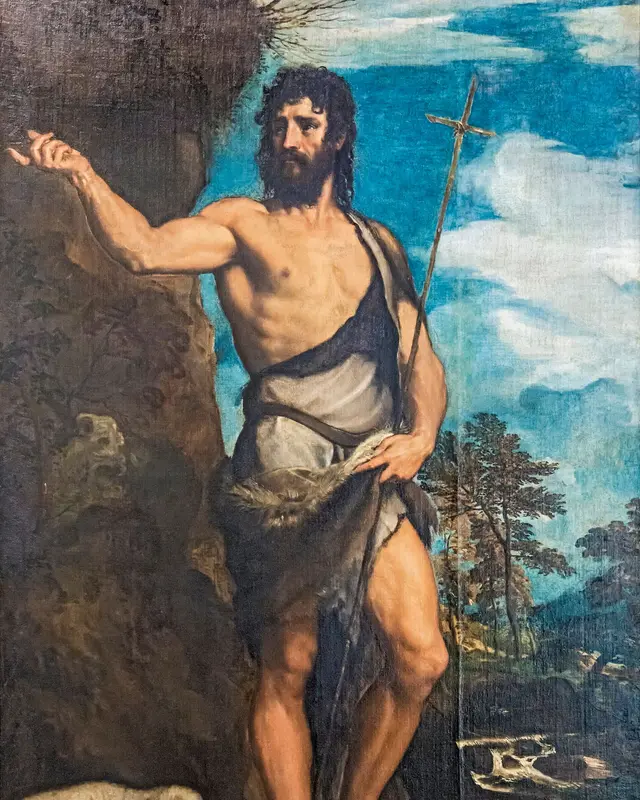
Saint John the Baptist
Wilderness prophet who prepared the way, executed under Herod Antipas
- Rank
- Saint
- Kind
- Martyr
- Life
- d. ~30
- Era
- 1st century
- Feast
- 29 August
- Countries
- Israel, Jordan
Life story
According to Luke's Gospel, John was the son of the priest Zechariah and Elizabeth, born when both were already old, in the hill country of Judea. He grew up and lived in the wilderness. The Gospels describe him wearing a garment of camel hair with a leather belt, and eating locusts and wild honey. He was a compelling prophet who called the people to repent.
John preached and baptised in the Jordan region, and many people came to hear him from Jerusalem and all over Judea. Jesus also came to be baptised by him, and the Gospels record this event as the start of his ministry. The Jewish historian Josephus, writing in the late first century, also mentions John as a teacher of virtue who baptised, and says that he was imprisoned and put to death.
John criticised King Herod Antipas for marrying Herodias, the wife of his brother, and was therefore arrested. The Gospels say he was beheaded at the request of Herodias's daughter. Josephus says he was held in the fortress of Machaerus on the eastern shore of the Dead Sea, now in Jordan, and that Antipas feared his influence over the people. The year of his death is not known with certainty but is usually placed between 28 and 32. Unusually, the Church celebrates both his birth, on 24 June, and his death, on 29 August, which shows how important he is in the Gospel accounts.
Works and witness
- Preached repentance and baptised in the Jordan region
- Baptised Jesus, according to all four Gospels
- Mentioned by the historian Josephus outside the New Testament
- Arrested by Herod Antipas for criticising the king's marriage
- Beheaded, according to tradition at the fortress of Machaerus
Patron of
Order of Malta
Saints from the same country
References
- Tân Ước: bốn sách Tin Mừng (New Testament: the four Gospels)
- Josephus, Jewish Antiquities
- Martyrologium Romanum
Written by Anawim from documented history. Some details about ancient saints rest on tradition and are marked as such.