

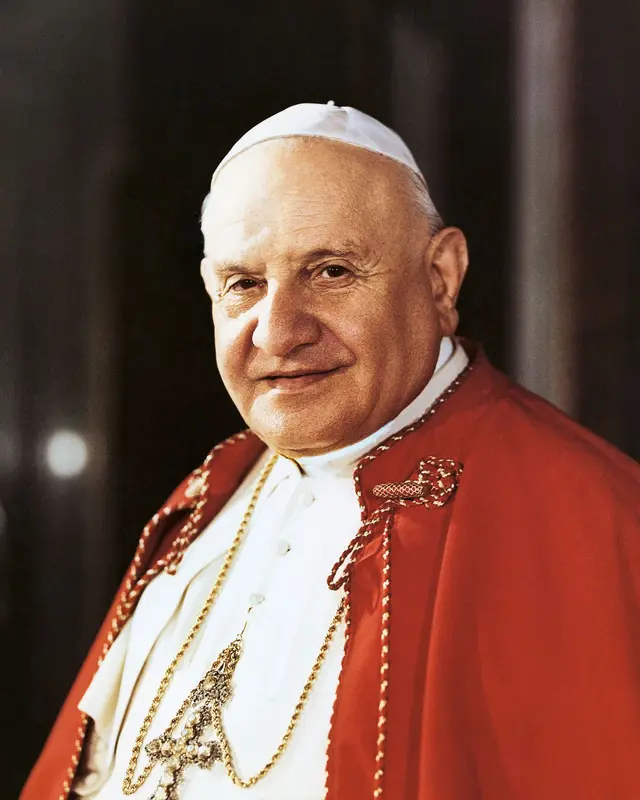
Saint John XXIII
The pope who convened the Second Vatican Council
- Rank
- Saint
- Kind
- Pope
- Life
- 1881 – 1963
- Era
- 20th century
- Feast
- 11 October
- Countries
- Italy, Vatican City
Life story
Angelo Giuseppe Roncalli was born on 25 November 1881 at Sotto il Monte, near Bergamo, into a large farming family. He entered the seminary young, was ordained priest in 1904 and served as secretary to the bishop of Bergamo, then as a military chaplain in the First World War. He afterwards worked in the Holy See's diplomatic service.
From 1925 he represented the Holy See in Bulgaria, then in Turkey and Greece, and in 1944 became nuncio to France. In 1953 Pius XII made him a cardinal and appointed him Patriarch of Venice.
On 28 October 1958 the cardinals elected him pope, and he took the name John XXIII at the age of seventy-six. In January 1959 he announced his intention to convene a general council, and the Second Vatican Council opened on 11 October 1962. He also issued the encyclicals Mater et Magistra (1961) and Pacem in Terris (1963).
He died on 3 June 1963 at the Vatican, when the Council had completed only its first session. John Paul II beatified him in 2000, and Pope Francis canonised him on 27 April 2014 together with John Paul II. As pope he was known for visiting prisoners and hospitals in Rome and for his informal, humorous manner. He also opened the way for contacts with other Christian churches, founding the Secretariat for Promoting Christian Unity in 1960 and receiving Orthodox and Anglican leaders at the Vatican.
Works and witness
- Served as papal representative in Bulgaria, Turkey, Greece and France
- Was Patriarch of Venice from 1953 and pope from 1958
- Convened the Second Vatican Council, opened on 11 October 1962
- Issued the encyclicals Mater et Magistra and Pacem in Terris
Saints from the same country
References
- Martyrologium Romanum
- Dicastery for the Causes of Saints – biographical profile
- Angelo Roncalli, Giornale dell'anima
Written by Anawim from documented history. Some details about ancient saints rest on tradition and are marked as such.