

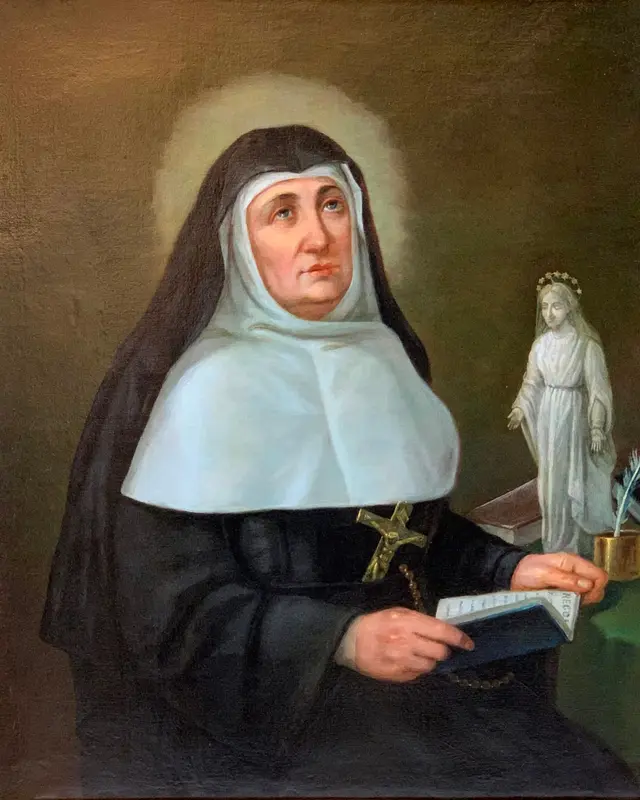
Saint Jeanne de Lestonnac
Niece of Montaigne, widow of Bordeaux, founder of an order for educating girls
- Rank
- Saint
- Kind
- Founder, Religious
- Life
- 1556 – 1640
- Era
- 17th century
- Countries
- France
Life story
Jeanne was born on 27 December 1556 in Bordeaux. Her father, Richard de Lestonnac, sat in the parliament of Bordeaux; her mother, Jeanne Eyquem, was a sister of the philosopher Michel de Montaigne. A speech of Pope Pius XII in 1949 says her mother was a Calvinist who tried to shape her daughter accordingly, and that her father then removed her education from that influence. According to her biographers she married Gaston de Montferrant at seventeen, in 1573, and had seven children.
After her husband's death, and after she had provided for her children, she entered a Feuillantine convent (a Cistercian reform) at about forty-six. Ill health forced her to leave after some six months. She lived as a devout lay woman.
With the advice of Jesuit priests she founded the Company of Mary, Our Lady (Compagnie de Notre-Dame), which combined contemplative life with the education of girls. Pope Paul V approved it on 7 April 1607, and the first sisters took vows on 10 December 1610. When she died in Bordeaux on 2 February 1640 the order had about thirty houses in France. Pope Leo XIII beatified her in 1900 and Pope Pius XII canonized her on 15 May 1949.
Works and witness
- Married at seventeen and raised her children after her husband's death
- Entered a Feuillantine convent but left after about six months because of illness
- Sought the advice of Jesuit priests about founding an order for girls
- Founded the Company of Mary, Our Lady, to educate girls; approved by Paul V in 1607
- Died on 2 February 1640; canonized on 15 May 1949
Saints from the same country
References
- Vatican, Pius XII, address to pilgrims for the canonization of Jeanne de Lestonnac, 17 May 1949
- Company of Mary, Our Lady (lestonnac-odn.org), 'Jeanne of Lestonnac' (1607 approval, 1949 canonization)
Written by Anawim from documented history. Some details about ancient saints rest on tradition and are marked as such.