

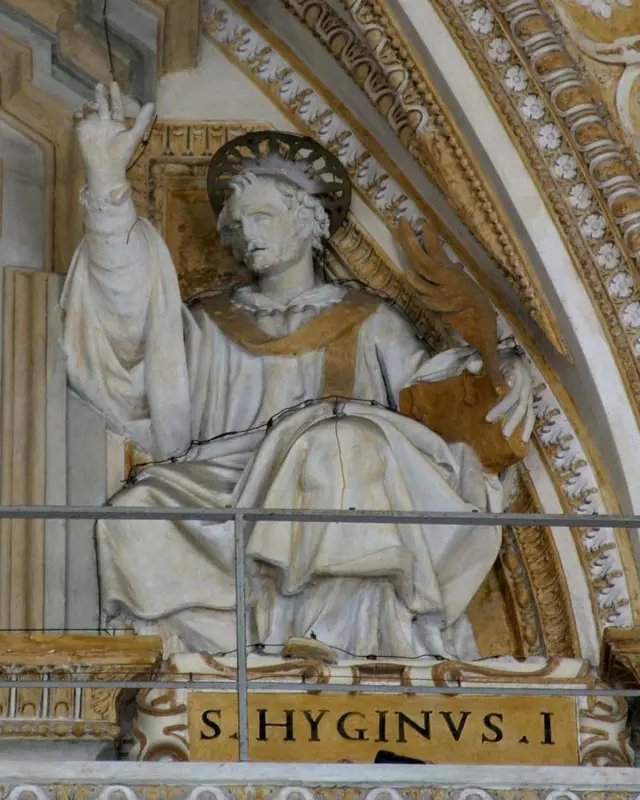
Pope Saint Hyginus
Greek-born second-century pope who lived through Valentinus and Cerdo's teaching in Rome
- Rank
- Saint
- Kind
- Pope
- Life
- d. ~142
- Era
- 2nd century
- Feast
- 11 January
- Countries
- Greece, Italy
Life story
According to the Liber Pontificalis, Hyginus was Greek; some modern works give Athens as his birthplace. His pontificate is placed at about 138 to 142, since Eusebius says he succeeded in the first year of the emperor Antoninus Pius and held office four years. The Catholic Encyclopedia stresses that the chronology of the early bishops of Rome cannot be fixed precisely. The idea that he was a philosopher, it suggests, probably arose from the similarity of his name to those of two Latin authors.
The most solid information about his time comes from Irenaeus: under Hyginus the Gnostic Valentinus came to Rome and stayed until the time of Anicetus. Cerdo also taught in Rome then; he recanted and was readmitted, but relapsed and was expelled.
The Liber Pontificalis later credits him with arranging the grades of the clergy. The Catholic Encyclopedia says this statement has no historical value, and Duchesne thought it could at most concern the lower orders. Tradition says he died a martyr, but no ancient source confirms it. He is said to have been buried on the Vatican hill near Peter's tomb. His feast is 11 January.
Works and witness
- Bishop of Rome from about 138 to 142
- Lived when Valentinus and Cerdo taught in Rome, according to Irenaeus
- The arrangement of clerical grades credited to him has no historical value
- Said to be buried on the Vatican hill near Peter's tomb
Saints from the same country
References
- Catholic Encyclopedia (New Advent), 'Pope St. Hyginus', 1910
- Irenaeus, Against Heresies and Eusebius, Church History, as cited in the Catholic Encyclopedia
Written by Anawim from documented history. Some details about ancient saints rest on tradition and are marked as such.