

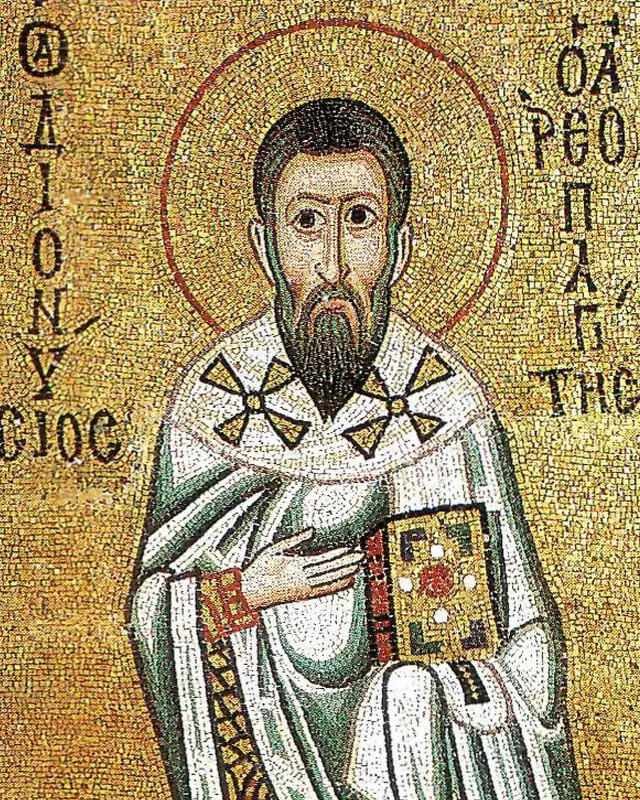
Saint Dionysius the Areopagite
Athenian councillor who believed after hearing Paul on the Areopagus
- Rank
- Saint
- Kind
- Bishop, Biblical figure
- Feast
- 3 October
- Countries
- Greece
Life story
Everything the Bible says about him fits into one verse of the Acts of the Apostles, chapter 17. Around the year 50 Paul reached Athens, argued with Jews and philosophers in the marketplace, and was brought to the Areopagus, where the city's council heard his account. Most listeners mocked him or put him off, but a few joined him and believed. Luke names two of them: Dionysius, a member of the Areopagus, and a woman called Damaris. He tells us nothing more.
Early Christian writers add a little. Eusebius, quoting a letter of Bishop Dionysius of Corinth from about 170, says that Dionysius the Areopagite was the first bishop of Athens. Some later sources add that he died as a martyr, but these are late and uncertain, so that detail cannot be treated as established history.
His reputation was later blended with two other figures. In the ninth century the abbey of Saint-Denis near Paris identified him with Denis, a third-century bishop of Paris, so the 9 October feast and the story of the severed head belong to Denis. Around the year 500 a body of Greek theological writings appeared under the name Dionysius the Areopagite; scholars now agree they were written by an unknown author centuries after Paul, usually called Pseudo-Dionysius. The current Roman Martyrology keeps the Areopagite on 3 October, separate from Saint Denis of Paris.
Works and witness
- Member of the Areopagus who believed after Paul's speech (Acts 17:34)
- Named with Damaris among the few converts in Athens
- According to Eusebius, the first bishop of Athens
- Confused with Saint Denis, bishop of Paris, from the Middle Ages on
- Writings under his name were composed by an unknown author around 500
Saints from the same country
References
- New Testament – Acts of the Apostles
- Eusebius, Ecclesiastical History
- Martyrologium Romanum
Written by Anawim from documented history. Some details about ancient saints rest on tradition and are marked as such.