

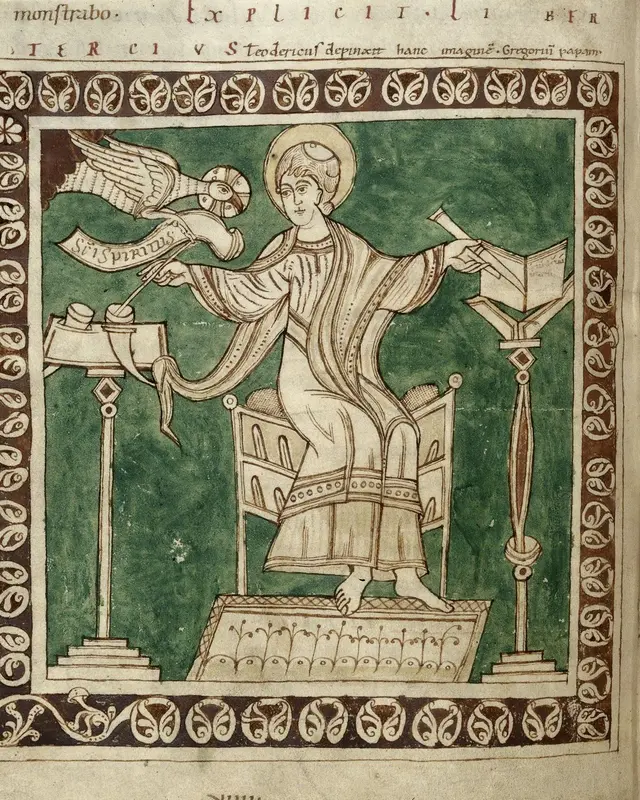
Saint Gregory the Great
Pope of Rome who reorganised relief for the poor and sent a mission to England
- Rank
- Saint
- Kind
- Pope, Doctor of the Church
- Life
- 540 – 604
- Era
- 7th century
- Feast
- 3 September
- Countries
- Italy
Life story
Gregory was born around 540 in Rome into a wealthy senatorial family. Around 572 he served as prefect of the city. He then turned his family home on the Caelian Hill into the monastery of St Andrew and lived there as a monk. In 579 the pope sent him as envoy to Constantinople; he stayed about six years before returning to Rome.
On 3 September 590 he was elected pope while Rome was suffering floods and plague and Italy was threatened by the Lombards. He reorganised the administration of the Church's estates to supply food to the city's poor and negotiated with the Lombards when imperial authority was distant.
In 596 he sent the monk Augustine, with companions, to England to preach to the Anglo-Saxons. He also left many writings, including the Pastoral Rule, the Moralia on Job, the Dialogues, and about eight hundred and fifty letters.
He died on 12 March 604. He is known as the Great and is one of the first four Latin Doctors of the Church. His feast is 3 September. He is traditionally linked with the plainchant that bears his name, Gregorian chant, though modern historians think the repertoire took shape after his time. He called himself the servant of the servants of God, a title later popes continued to use. His letters are an important source for the history of the sixth-century West.
Works and witness
- Prefect of Rome around 572, then monk on the Caelian Hill
- Pope from 590 to 604
- Sent Augustine of Canterbury to England in 596
- Wrote the Pastoral Rule, the Moralia and the Dialogues
Patron of
Teachers, Musicians
Saints from the same country
References
- Gregory the Great, Registrum epistolarum
- Gregory the Great, Regula pastoralis
- Martyrologium Romanum
Written by Anawim from documented history. Some details about ancient saints rest on tradition and are marked as such.