

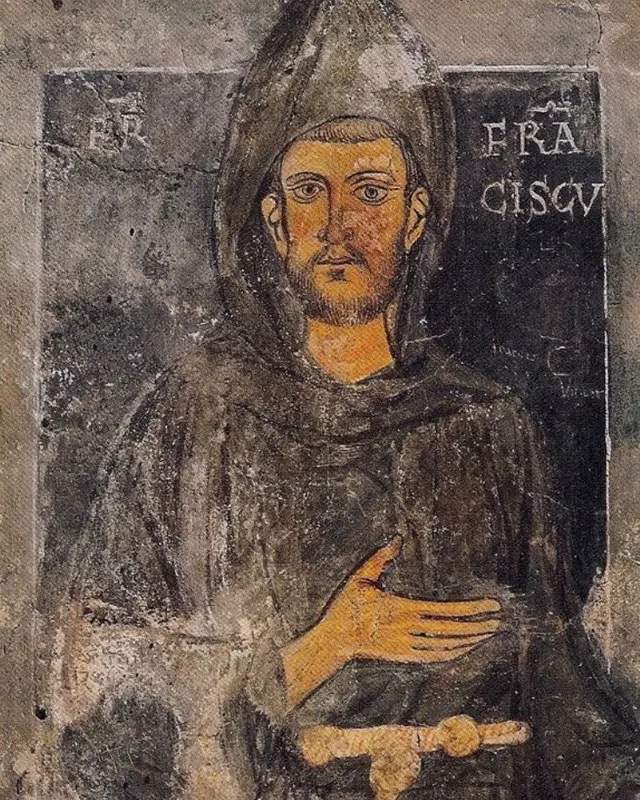
Saint Francis of Assisi
Cloth merchant's son of Assisi who embraced poverty and founded the Friars Minor
- Rank
- Saint
- Kind
- Founder, Religious
- Life
- 1181 – 1226
- Era
- 13th century
- Feast
- 4 October
- Countries
- Italy
Life story
Francis was born around 1181 or 1182 in Assisi, the son of Pietro di Bernardone, a cloth merchant. In his youth he lived a carefree life and dreamed of becoming a knight; after being taken prisoner in the war between Assisi and Perugia in 1202 and falling ill, he gradually changed his way of life. He renounced his inheritance in front of his father and the bishop of Assisi, then lived as a penitent, repairing ruined chapels, among them San Damiano.
Others slowly joined him. Around 1209 or 1210 Pope Innocent III approved the group's short rule, and the order of Friars Minor took shape. The brothers lived in poverty, preached and did manual work, with the chapel of the Portiuncula near Assisi as their centre. In 1219 Francis travelled to Egypt and met Sultan al-Kamil during the Fifth Crusade.
In 1223 he arranged a Nativity scene at Greccio. According to early biographies, in 1224 he received the stigmata on Mount La Verna. In his last years, ill and nearly blind, he composed the Canticle of the Creatures in vernacular Italian, one of the earliest works of Italian literature.
Francis died at the Portiuncula on 3 October 1226. Two years later Pope Gregory IX canonised him. In 1939 he was named one of the patrons of Italy together with Catherine of Siena, and in 1979 Pope John Paul II declared him patron of those who work for ecology.
Works and witness
- Renounced his inheritance and lived in poverty in Assisi
- Rule approved by Innocent III around 1209-1210
- Met Sultan al-Kamil in Egypt in 1219
- Arranged the Nativity scene at Greccio in 1223
- Composed the Canticle of the Creatures
Patron of
Italy, Ecology
Saints from the same country
References
- Martyrologium Romanum
- Thomas of Celano, Vita prima
- Francis of Assisi, Canticle of the Creatures
Written by Anawim from documented history. Some details about ancient saints rest on tradition and are marked as such.