

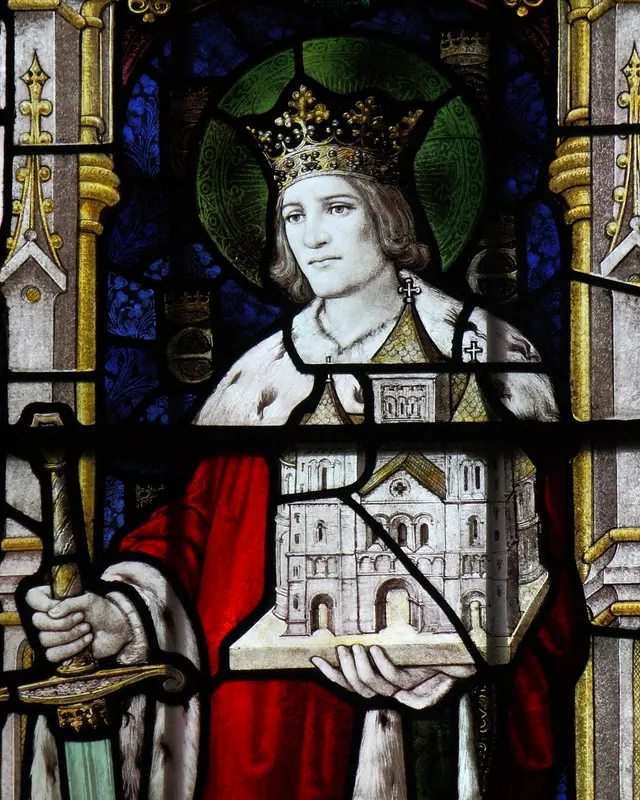
Saint Edwin of Northumbria
Northumbrian king baptised in 627, killed at Hatfield Chase
- Rank
- Saint
- Kind
- Royalty
- Life
- 586 – 633
- Era
- 7th century
- Feast
- 12 October
- Countries
- United Kingdom
Life story
According to Bede, Edwin was born around 586 in the kingdom of Deira, a son of King Ælle. After Æthelfrith conquered Deira he spent many years in exile. By about 616 he was under the protection of King Rædwald of East Anglia, who defeated Æthelfrith at the River Idle in 616 and set Edwin on the throne to rule both Deira and Bernicia.
Around mid-625 Edwin married Æthelburh, sister of King Eadbald of Kent. The alliance was concluded at Canterbury and, according to Bede, the match was tied to Edwin's later conversion. Bishop Paulinus came north with her. Edwin was baptised in 627, traditionally on 12 April, together with his leading men. Bede also tells vivid stories such as that of the pagan priest Coifi destroying the idols, but these rest on his account alone. Paulinus became the first bishop of York.
From about 627 Edwin was the most powerful of the Anglo-Saxon kings, a position Bede describes with the word imperium. He was killed at the Battle of Hatfield Chase in 632 or 633 by the forces of the British king Cadwallon and the pagan king Penda of Mercia. His feast is kept on 12 October, the day recorded as that of his death.
After his death Northumbria split in two and both successor kings returned to paganism before Oswald reunited the kingdom. Æthelburh returned to Kent with Paulinus. Edwin's cult was later overshadowed by that of King Oswald.
Works and witness
- Became king of Deira and Bernicia around 616 with Rædwald's help
- Married Æthelburh of Kent around 625
- Baptised in 627 by Bishop Paulinus
- Killed at Hatfield Chase in 632 or 633
Saints from the same country
References
- Catholic Encyclopedia (New Advent), St. Edwin (newadvent.org/cathen/05323b.htm)
- Britannica, Edwin, king of Northumbria; York Minster entry
- Bede, Ecclesiastical History of the English People, II (as summarized in the above)
Written by Anawim from documented history. Some details about ancient saints rest on tradition and are marked as such.