

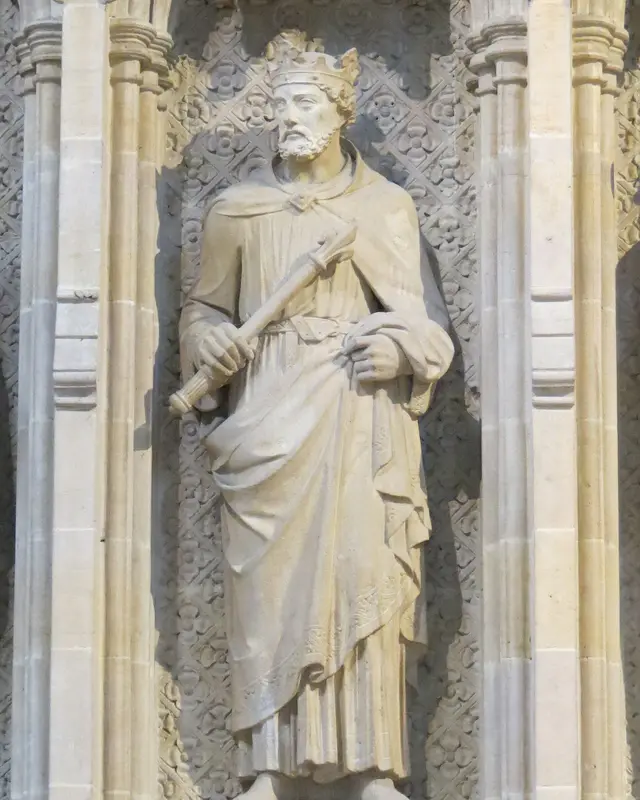
Saint Æthelberht of Kent
King of Kent who received Augustine of Canterbury and issued the first written English law code
- Rank
- Saint
- Kind
- Royalty
- Life
- 550 – 616
- Era
- 7th century
- Feast
- 24 February
- Countries
- United Kingdom
Life story
Æthelberht was a son of King Eormenric of Kent. His birth date and the start of his reign are uncertain: sources place his birth between about 550 and 560, and his accession around 589 or 590. He married Bertha, a Christian Frankish princess, which tied Kent to the Frankish court. Bertha brought a chaplain with her and used an old Roman-era church at Canterbury.
In 597 the mission led by Augustine, sent by Pope Gregory the Great, landed on the Isle of Thanet. The king gave them a dwelling at Canterbury. According to Bede and later sources he soon accepted baptism, possibly at Whitsun 597, though the exact date is uncertain. He did not force his subjects to follow. He endowed the church at Canterbury and built and endowed St Paul's in London.
Around 602 to 604 he issued a law code of about ninety sections. It is the earliest surviving code in any Germanic language, preserved in the twelfth-century Textus Roffensis, and its opening clauses set compensation for theft of Church property and from the clergy. Bede lists him as the third king to hold imperium over the other Anglo-Saxon kingdoms.
He died in 616 (some sources say 618) and was succeeded by his son Eadbald. By tradition he was buried at Canterbury. The Catholic Church now keeps his memorial on 24 February.
Works and witness
- Married Bertha, a Christian Frankish princess
- Welcomed Augustine's mission in 597 and was baptised
- Issued a law code around 602–604
- Endowed churches at Canterbury and London
Saints from the same country
References
- Catholic Encyclopedia (New Advent), St. Ethelbert, King of Kent (newadvent.org/cathen/05553b.htm)
- Britannica, Aethelberht I
- Bede, Ecclesiastical History of the English People, I-II (via the above)
Written by Anawim from documented history. Some details about ancient saints rest on tradition and are marked as such.