

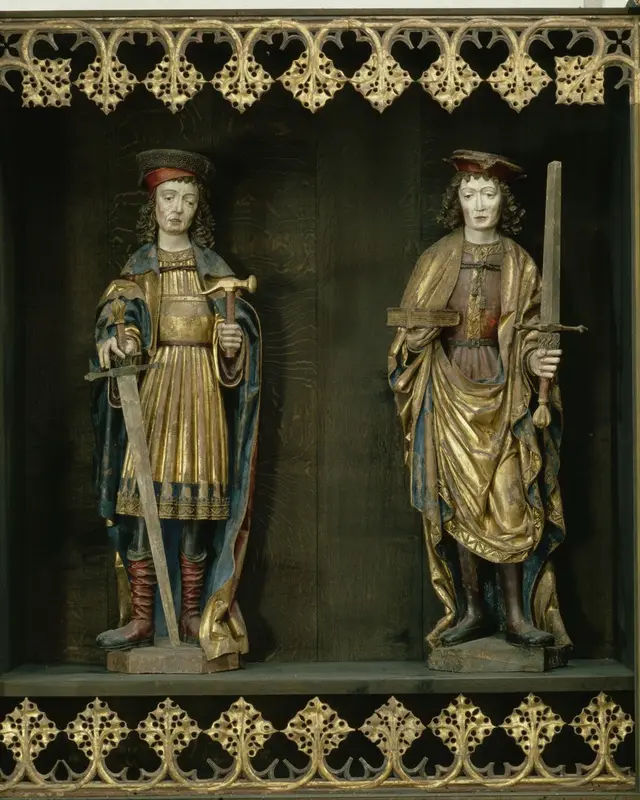
Saints Crispin and Crispinian
Twin brothers who, in legend, were shoemaker-missionaries at Soissons beheaded under Diocletian
- Rank
- Saint
- Kind
- Martyr, Layperson
- Feast
- 25 October
- Countries
- France, Italy
Life story
According to legend, Crispin and Crispinian were brothers of a distinguished Roman family who came to Gaul as missionaries and made Soissons their base. To support themselves they made shoes. Their beheading under the emperor Diocletian is placed on 25 October 285 or 286, so the exact year is uncertain. Other details of the legend, such as the governor Rictiovarus, have little historical value according to the Catholic Encyclopedia.
The Catholic Encyclopedia observes that a large church was built over the graves of the two saints, so the legend could not have arisen until a later age. In the sixth century a grand basilica stood at Soissons over their graves. Their remains were later divided, part going to Osnabrück and part to Rome. They are regarded as patrons of shoemakers, tanners, saddlers and other leather trades.
The feast day also became famous because the Battle of Agincourt in 1415 was fought on 25 October, and the St Crispin's Day speech in Shakespeare's Henry V made the date familiar. After Vatican II their feast was dropped from the general Catholic calendar, though they remain in the Roman Martyrology.
Works and witness
- In legend, preached at Soissons in Gaul while working as shoemakers
- Beheaded under Diocletian on 25 October 285 or 286
- A basilica over their graves at Soissons dates from the sixth century
- Their feast day coincides with the Battle of Agincourt in 1415
Patron of
Shoemakers, Tanners, Saddlers
Saints from the same country
References
- Catholic Encyclopedia (New Advent), 'Sts. Crispin and Crispinian', 1908
Written by Anawim from documented history. Some details about ancient saints rest on tradition and are marked as such.