

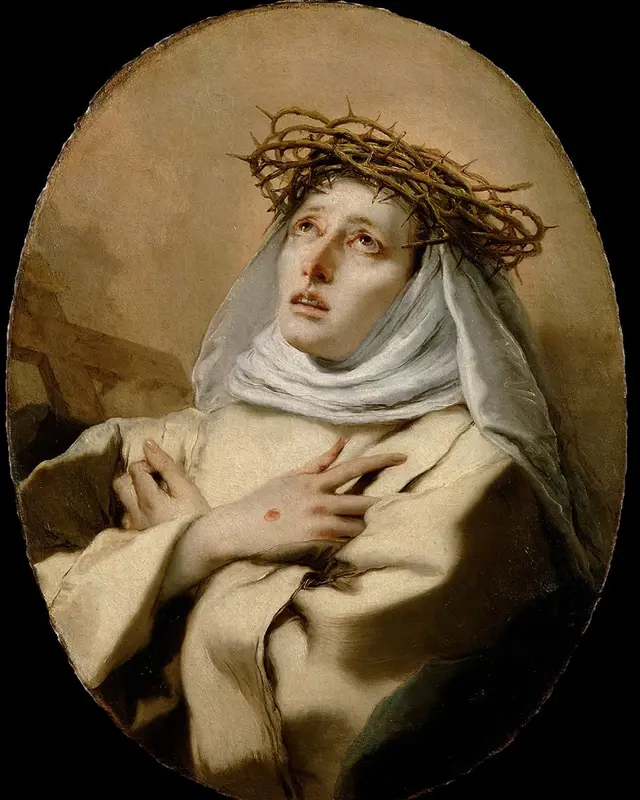
Saint Catherine of Siena
Dominican tertiary of Siena who wrote to popes and rulers and died at thirty-three
- Rank
- Saint
- Kind
- Mystic, Doctor of the Church, Layperson
- Life
- 1347 – 1380
- Era
- 14th century
- Feast
- 29 April
- Countries
- Italy
Life story
Catherine was born in 1347 at Siena, the daughter of the dyer Giacomo Benincasa and one of about twenty-five children. From early childhood she wished to live a life of prayer, and at about sixteen she joined the group of women who lived according to the Dominican third order, residing at home but wearing the habit. For several years she lived in seclusion, and then turned to caring for the sick and the poor.
A circle of disciples gathered round her. She dictated many letters to kings, city rulers, bishops and popes. In 1376 she went to Avignon to urge Pope Gregory XI to return to Rome, and he did so in early 1377. Tuscan cities also asked her to act as mediator with the Holy See.
In 1378 the Western Schism broke out after the election of Urban VI, and Catherine supported him, writing to kings and bishops to urge their acceptance. She was summoned to Rome, where she spent her last years. Her Dialogue, recorded by her disciples, is one of her most important spiritual works.
Catherine died in Rome on 29 April 1380, aged thirty-three. Pope Pius II canonised her in 1461. In 1939 Pius XII named her one of the patrons of Italy together with Francis of Assisi; in 1970 Paul VI declared her a Doctor of the Church, and in 1999 John Paul II made her a co-patron of Europe.
Works and witness
- Joined the Dominican third order in Siena around 1363
- Wrote hundreds of letters to popes and rulers
- Went to Avignon in 1376 to urge the Pope to return to Rome
- Supported Urban VI in the schism of 1378
- Declared a Doctor of the Church in 1970
Patron of
Italy, Europe (co-patron)
Saints from the same country
References
- Martyrologium Romanum
- Catherine of Siena, Il Dialogo della Divina Provvidenza
- Raymond of Capua, Legenda maior
Written by Anawim from documented history. Some details about ancient saints rest on tradition and are marked as such.