

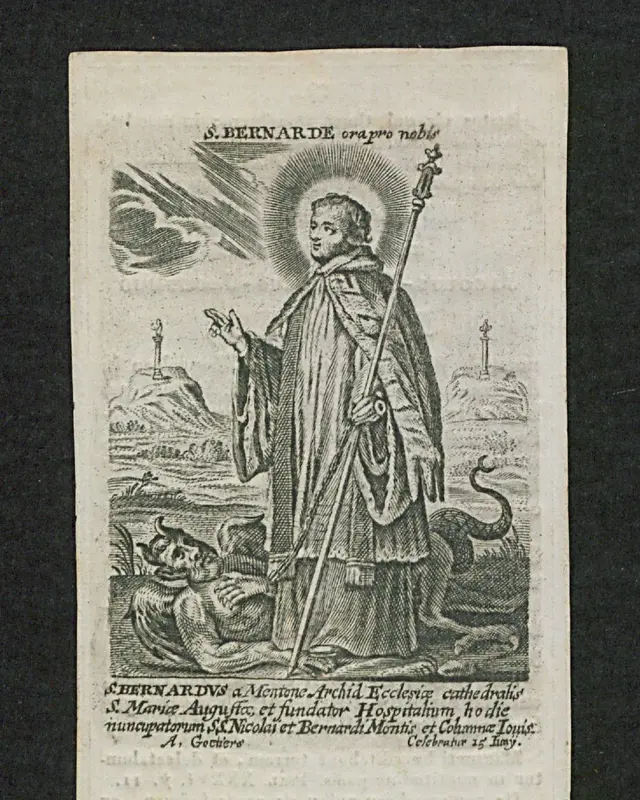
Saint Bernard of Menthon
Archdeacon of Aosta, tied to the travellers' hospices of the Great St Bernard Pass
- Rank
- Saint
- Kind
- Priest
- Feast
- 28 May
- Countries
- France, Italy
Life story
Bernard is recorded as archdeacon of the cathedral of Aosta, the official in charge of running the diocese. According to the Catholic Encyclopedia, he established a monastery and hospice at the highest point of the Great St Bernard in 962, and a few years later another on the Little St Bernard. Britannica describes him as vicar general of the diocese of Aosta who re-established and was patron of the hospices at the summits of the two passes. Sources disagree on the founding date, so 962 should be read as traditional.
The dates of his life are also uncertain. The Catholic Encyclopedia gives his life as 923 to 1008, while Britannica gives 1081 with a question mark. His birthplace is vague too: legend places it at the castle of Menthon near Annecy, but this is disputed. The story that he jumped from a window to escape an arranged marriage and was caught by angels is legend.
The hospices he founded were later run by canons regular and became known for welcoming travellers across the Alps. The St Bernard dog breed is associated with the hospice. He was venerated locally from the twelfth century and was canonised by Pope Innocent XI in 1681. In 1923 Pope Pius XI named him patron of mountain climbers. His feast is given as 28 May or 15 June.
Works and witness
- Archdeacon of the diocese of Aosta
- Founded or re-established the hospice on the Great St Bernard, traditionally in 962
- Founded a further hospice on the Little St Bernard
- Canonised by Pope Innocent XI in 1681
- Named patron of mountain climbers by Pius XI in 1923
Patron of
Mountain climbers, The Alps
Saints from the same country
References
- Catholic Encyclopedia (New Advent), 'St. Bernard of Menthon', 1907
- Britannica, 'Saint Bernard de Menthon' (print version: dates with query, 1923 patronage, feast 28 May)
Written by Anawim from documented history. Some details about ancient saints rest on tradition and are marked as such.