

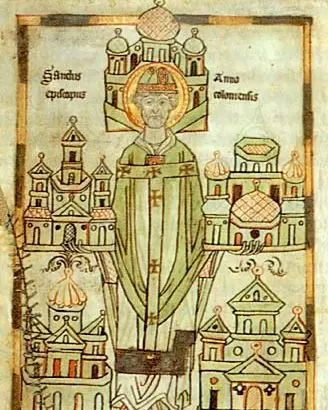
Saint Anno of Cologne
Archbishop of Cologne, adviser of young Henry IV and founder of Siegburg Abbey
- Rank
- Saint
- Kind
- Bishop
- Life
- 1010 – 1075
- Era
- 11th century
- Feast
- 4 December
- Countries
- Germany
Life story
Anno was born around 1010 in Swabia into a noble family. According to the Catholic Encyclopedia he was a soldier before entering the clergy under his uncle, a canon of Bamberg. His learning and virtue led Emperor Henry III to call him to court; he became a royal chaplain and in 1054 provost at Goslar.
In 1055 or 1056 (sources differ) he became archbishop of Cologne, reportedly accepting the office reluctantly. After Henry III's death, Empress Agnes entrusted him with the education of the young Henry IV. Historians record that in April 1062 he led the party that seized Henry from his mother's care at Kaiserswerth. Henry resented his strictness, and Anno lost the regency; in 1072 he returned to power.
Anno was known for constant prayer, severe penance, frequent preaching and wide charity. He reformed the monasteries of his diocese and founded five new ones for canons regular and Benedictines, among them St Michael's Abbey (Michaelsberg) at Siegburg, founded in 1064. Historians record that the citizens of Cologne rose against him at Easter 1074 and were put down within a few days.
He died on 4 December 1075 at Siegburg and was buried there. According to the sources he was canonised in 1183 under Pope Lucius III. His feast day is 4 December, and his main shrine is Michaelsberg Abbey at Siegburg.
Works and witness
- Royal chaplain to Henry III, then archbishop of Cologne from the mid-1050s
- Led the seizure of Henry IV from his mother's guardianship in 1062
- Founded St Michael's Abbey at Siegburg in 1064 and other monasteries
- The citizens of Cologne rose against him in 1074
- Died 4 December 1075; canonised in 1183
Saints from the same country
References
- Catholic Encyclopedia, “St. Anno”, newadvent.org/cathen/01541b.htm
- Britannica, “Saint Anno”
Written by Anawim from documented history. Some details about ancient saints rest on tradition and are marked as such.