

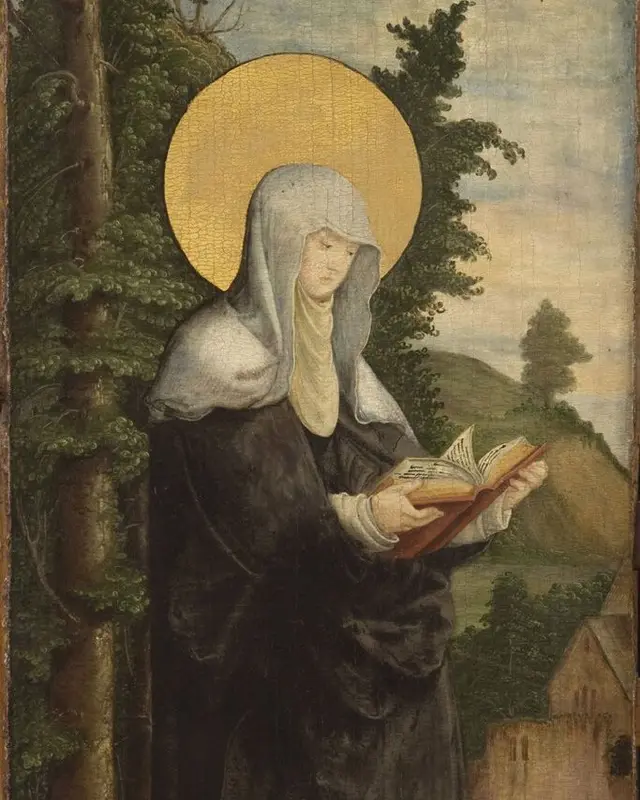
Saint Walburga
Anglo-Saxon nun who helped Saint Boniface and became abbess at Heidenheim
- Rank
- Saint
- Kind
- Virgin, Missionary, Religious
- Life
- d. 779
- Era
- 8th century
- Feast
- 25 February
- Countries
- United Kingdom, Germany
Life story
Walburga was born around 710, probably at Crediton in Devon. Her father was Richard the Pilgrim and her mother Wuna of Wessex; her brothers Willibald and Winibald were also missionaries. She was educated and became a nun at Wimborne in Dorset.
She later went to Francia with her brothers to help Saint Boniface evangelise the region. She helped her brothers at the double monastery of Heidenheim, where Winibald led the monks and she the nuns; after Winibald's death (761 according to the Catholic Encyclopedia) she ruled both communities. A narrative of her miracles, the Miracula S. Walburgae Manheimensis by Wolfhard of Herrieden, can be dated to 895 or 896.
She died on 25 February 777 or 779; the sources disagree. Her remains were moved to Eichstätt in 870. Her feast is 25 February; 1 May commemorates the translation of her relics, and Walpurgis Night, the eve of May Day, takes her name. Her bones were said to exude a healing oil known as Walpurgis oil. She is patron of Eichstätt, Antwerp and several other towns.
Works and witness
- Nun at Wimborne in Dorset
- Went to Francia to work with Saint Boniface
- Head of the double monastery at Heidenheim after her brother Winibald's death
- Relics moved to Eichstätt in 870
- Walpurgis Night is named after her
Patron of
Eichstätt, Antwerp
Saints from the same country
References
- Catholic Encyclopedia, "St. Walburga" (newadvent.org/cathen/15526b.htm)
- Catholic Encyclopedia, "Sts. Willibald and Winnebald"
Written by Anawim from documented history. Some details about ancient saints rest on tradition and are marked as such.