

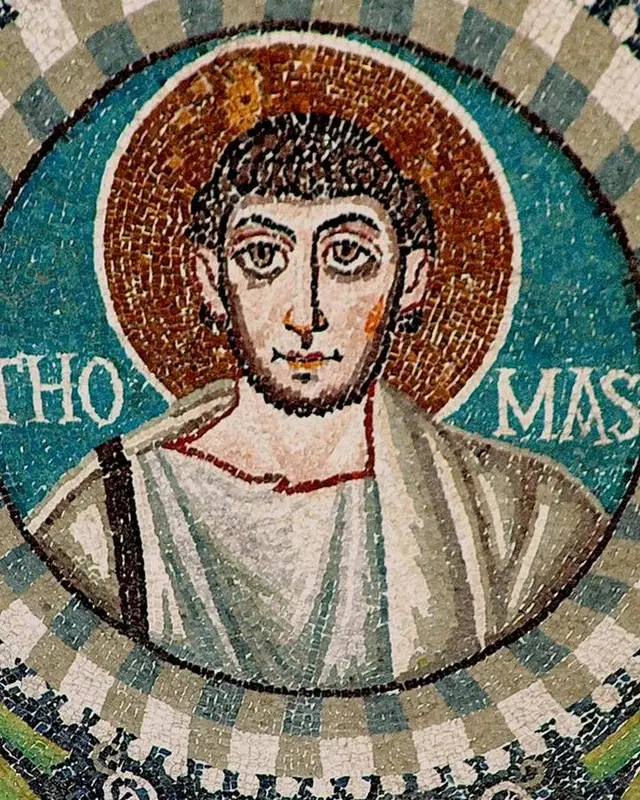
Saint Thomas the Apostle
The disciple remembered for his doubt and, by tradition, a missionary in India
- Rank
- Saint
- Kind
- Apostle, Martyr, Missionary
- Life
- d. ~72
- Era
- 1st century
- Feast
- 3 July
- Countries
- Israel, India
Life story
Thomas, an Aramaic name meaning twin and rendered in Greek as Didymus, is mentioned in several passages of John's Gospel. When Jesus decided to return to Judea to go to Lazarus, Thomas told his fellow disciples that they should go along and die with him. At the Last Supper he asked Jesus directly about the way he was about to take.
The best known passage says he was absent when Jesus appeared to the disciples after the Resurrection, and that he said he would believe only if he saw the wounds himself. Eight days later Jesus appeared again, and Thomas declared him his Lord and his God. This scene is why his name is so often tied to doubt, but the Gospel itself stresses the confession of faith at the end.
The New Testament says nothing more about his life afterwards. Syrian and Indian Christian traditions say he travelled east to southern India, founded communities that are today called the Saint Thomas Christians of Kerala, and was martyred near Mylapore, now part of Chennai, around the year 72. Historians still debate how certain these details are, but the tradition is very old and firmly rooted in India. His feast is kept on 3 July, and the churches of Kerala continue to use Syriac in their liturgy, a sign of their old links with the Christian East. Portuguese explorers who reached India at the end of the fifteenth century found these communities already ancient and well established.
Works and witness
- One of the Twelve, also called Didymus, meaning twin
- Professed his faith after meeting the risen Jesus, in John's Gospel
- According to tradition, travelled east and reached southern India
- The Saint Thomas Christians of Kerala trace their origins to him
- According to tradition, martyred near Mylapore, India, around 72
Patron of
India, Architects
Saints from the same country
References
- Tân Ước: Tin Mừng Gioan (New Testament: Gospel of John)
- Eusebius, Church History
- Martyrologium Romanum
Written by Anawim from documented history. Some details about ancient saints rest on tradition and are marked as such.