

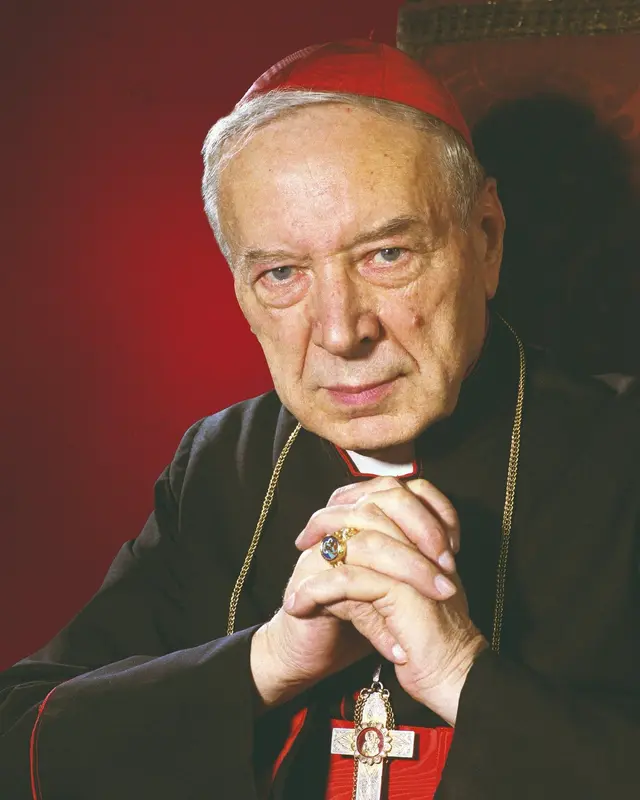
Blessed Stefan Wyszyński
Polish Cardinal Primate who steered the Church through decades of communist rule
- Rank
- Blessed
- Kind
- Bishop
- Life
- 1901 – 1981
- Era
- 20th century
- Feast
- 28 May
- Countries
- Poland
Life story
Stefan Wyszyński was born on 3 August 1901 at Zuzela, then in the Russian Empire. He was ordained a priest in 1924, worked in social ministry before the war, and during the Second World War had to hide to avoid arrest by the Germans. He became bishop of Lublin in 1946 and on 12 November 1948 archbishop of Gniezno and Warsaw, with the title Primate of Poland.
As the communist authorities pressed the Church, he reached an agreement with the state in 1950, but later protested against state interference in the appointment and trial of bishops and priests. On 25 September 1953 he was arrested and held in several places until his release on 26 October 1956. Earlier, in January 1953, Pius XII had made him a cardinal.
After his release he led the Great Novena (1957–1966), a preparation for the thousandth anniversary of Poland's Christian baptism. In 1965, together with the Polish bishops, he sent a letter to the German bishops offering forgiveness and asking for it, an important step in post-war reconciliation. He was close to Karol Wojtyła, and sources record that he urged him to accept election as pope in 1978.
He died in Warsaw on 28 May 1981. He was beatified in Warsaw on 12 September 2021, with Cardinal Marcello Semeraro presiding on behalf of Pope Francis.
Works and witness
- Became archbishop of Gniezno and Warsaw and Primate of Poland in 1948
- Imprisoned from September 1953 to October 1956
- Led the Great Novena preparing Poland's millennium of Christianity
- Co-signed the 1965 letter of reconciliation to the German bishops
- Beatified in 2021
Saints from the same country
References
- Martyrologium Romanum
- Vatican news on the beatification of Cardinal Wyszyński, 12 September 2021
- Biographies of Cardinal Wyszyński
Written by Anawim from documented history. Some details about ancient saints rest on tradition and are marked as such.