

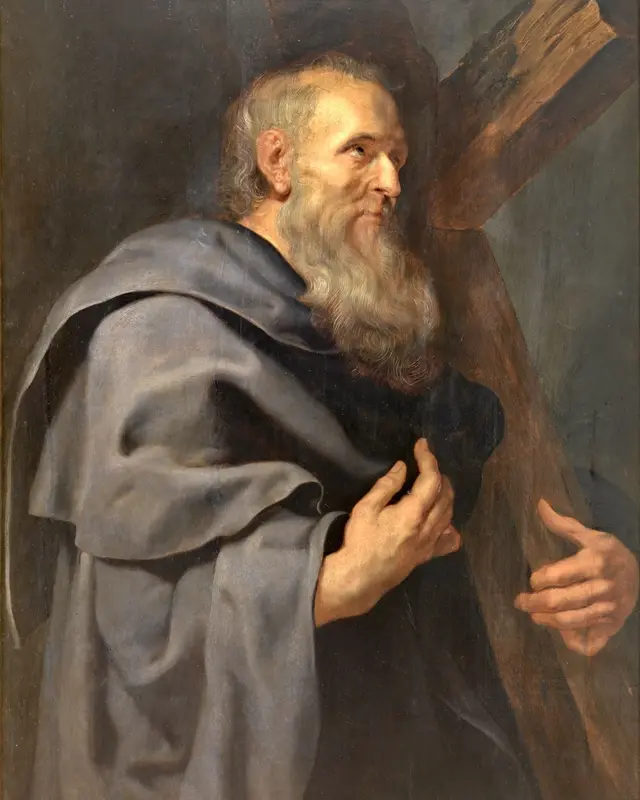
Saint Philip the Apostle
The man from Bethsaida who brought Nathanael to meet Jesus
- Rank
- Saint
- Kind
- Apostle, Martyr
- Feast
- 3 May
- Countries
- Israel, Türkiye
Life story
Philip came from Bethsaida on the shore of the Sea of Galilee, the same town as Andrew and Simon Peter. John's Gospel presents him as one of the first people Jesus called. Almost at once he went to find Nathanael and urged his friend to come and see for himself. His name appears in every list of the Twelve, always among the first four. It is a Greek name, which hints at how strongly Greek culture had reached the region where he lived.
John's Gospel links three moments to him. Before the feeding of the crowd, Jesus asks him where bread could be bought for so many people, and he answers that two hundred days of wages would not be enough. Later, a group of Greeks who had come to Jerusalem asked to see Jesus and approached Philip first; he and Andrew passed on the request. At the Last Supper it is Philip who asks Jesus to show the disciples the Father. He should not be confused with Philip the deacon in the Acts of the Apostles, who preached in Samaria.
The New Testament says nothing of his life after Pentecost. According to ancient traditions he preached in Phrygia in Asia Minor and died at Hierapolis, near modern Pamukkale in Turkey. The details of how he died differ from one source to another and cannot be verified, so they belong to tradition rather than history. His relics are kept in the Basilica of the Twelve Holy Apostles in Rome, together with those of James the Less. The two apostles share a feast on 3 May.
Works and witness
- From Bethsaida, called very early and counted among the Twelve
- Brought Nathanael to Jesus, according to John's Gospel
- Carried the request of a group of Greeks to see Jesus
- By tradition, preached in Phrygia and died at Hierapolis
- Relics honoured in the Basilica of the Twelve Holy Apostles, Rome
Saints from the same country
References
- Tân Ước / New Testament (Gospel of John; Acts of the Apostles)
- Martyrologium Romanum
- Eusebius of Caesarea, Historia Ecclesiastica
Written by Anawim from documented history. Some details about ancient saints rest on tradition and are marked as such.