

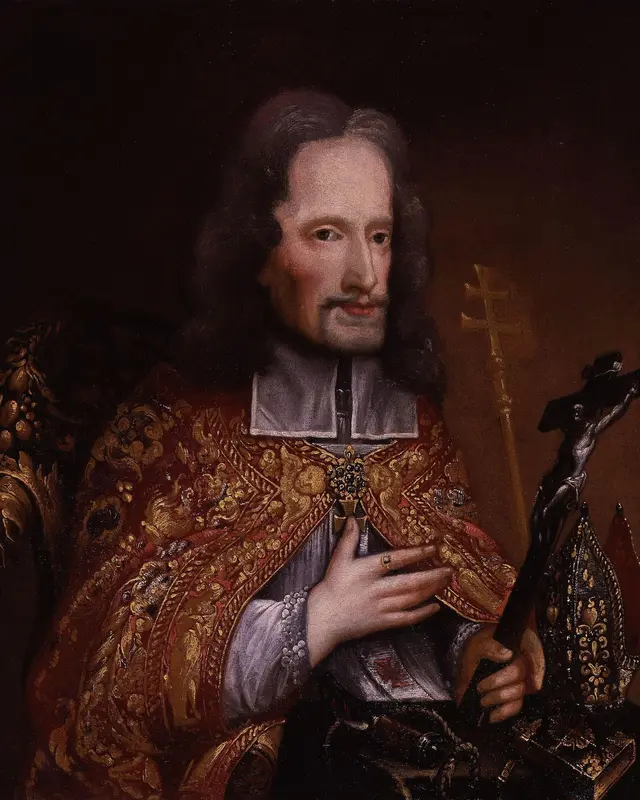
Saint Oliver Plunkett
Archbishop of Armagh, executed at Tyburn on a fabricated charge of plotting
- Rank
- Saint
- Kind
- Martyr, Bishop
- Life
- 1625 – 1681
- Era
- 17th century
- Feast
- 1 July
- Countries
- Ireland, United Kingdom
Life story
Oliver Plunkett was born on 1 November 1625 at Loughcrew, County Meath, Ireland. He went to Rome to study in 1647 and was ordained a priest there. He stayed in Rome for many years, teaching theology at the Propaganda Fide college. In 1669 he was appointed archbishop of Armagh and Primate of All Ireland, at a time when governing the Catholic Church in Ireland was very difficult.
In Ireland he worked tirelessly, opening schools and trying to restore clerical discipline. Matters worsened in 1678, when Titus Oates put forward a fabricated allegation of a Catholic conspiracy, usually called the Popish Plot. Plunkett was arrested in December 1679 and taken to London for trial. The trial is widely regarded as a serious miscarriage of justice, and in June 1681 he was found guilty of treason.
He was hanged, drawn and quartered at Tyburn on 1 July 1681, aged fifty-five, the last Catholic to be executed in that way in England for his faith. His head is now kept at St Peter's Church in Drogheda, and most of his body at Downside Abbey in England. He was beatified on 23 May 1920 and canonised by Pope Paul VI on 12 October 1975. The Church keeps his feast on 1 July. An earlier attempt to try him in Ireland, at Dundalk, collapsed for lack of witnesses. At the London trial he was refused enough time to bring witnesses from Ireland to speak in his defence.
Works and witness
- Studied and taught theology in Rome for many years
- Archbishop of Armagh from 1669
- Arrested in December 1679 during the Popish Plot panic
- Executed at Tyburn on 1 July 1681
- Canonised in 1975
Saints from the same country
References
- Martyrologium Romanum
- Dicastery for the Causes of Saints – biographical profile
- Oxford Dictionary of National Biography, 'Plunkett, Oliver'
Written by Anawim from documented history. Some details about ancient saints rest on tradition and are marked as such.