

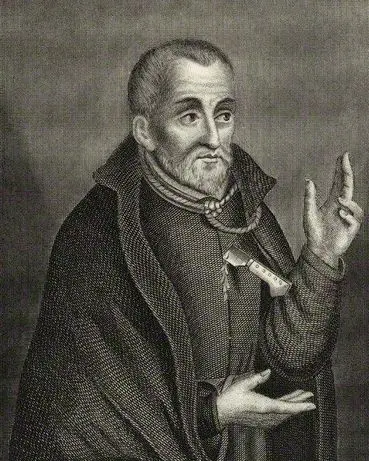
Saint Edmund Campion
Oxford scholar turned Jesuit, executed at Tyburn in 1581
- Rank
- Saint
- Kind
- Martyr, Priest
- Life
- 1540 – 1581
- Era
- 16th century
- Feast
- 1 December
- Countries
- United Kingdom
Life story
Edmund Campion was born in London in 1540. He was an outstanding scholar, studied and taught at St John's College, Oxford, and drew the attention of Queen Elizabeth I. He later left the Church of England for Catholicism, left England and studied at Douai. In 1573 he joined the Society of Jesus in Rome, and was then sent to Prague, where he taught for several years.
In 1580 he returned to England with Robert Persons on a secret mission to serve Catholics living under prohibition. He moved from place to place, often in hiding, preaching and administering the sacraments. During this time he wrote the Latin tract Decem Rationes, an argument against the Church of England, which circulated widely at Oxford. In 1581 a spy found him at Lyford Grange and he was arrested.
He was held in the Tower of London, tortured, and tried for treason, a charge he denied. Campion was hanged, drawn and quartered at Tyburn on 1 December 1581, aged forty-one. He was beatified in 1886 and canonised by Pope Paul VI on 25 October 1970 among the Forty Martyrs of England and Wales. The Church keeps his feast on 1 December. Early accounts say that at his trial and at the gallows he spoke calmly, declared his loyalty to the queen in civil matters, and prayed for her. His pamphlet Decem Rationes had been left on the benches of the university church at Oxford, causing a stir.
Works and witness
- Studied and taught at St John's College, Oxford
- Joined the Jesuits in Rome in 1573 and taught in Prague
- Returned to England on a secret mission with Robert Persons in 1580
- Wrote the Latin tract Decem Rationes
- Executed at Tyburn on 1 December 1581
Saints from the same country
References
- Martyrologium Romanum
- Dicastery for the Causes of Saints – biographical profile
- Evelyn Waugh, Edmund Campion
Written by Anawim from documented history. Some details about ancient saints rest on tradition and are marked as such.