

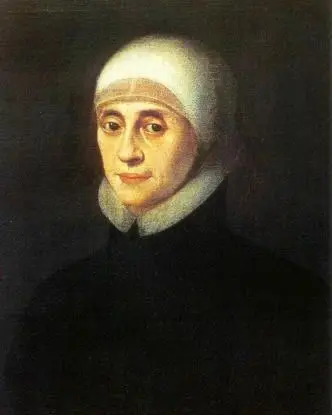
Venerable Mary Ward
Yorkshire woman who sought an active, uncloistered life for religious sisters
- Rank
- Venerable
- Kind
- Founder, Religious
- Life
- 1585 – 1645
- Era
- 17th century
- Countries
- United Kingdom, Belgium, Germany, Italy
Life story
Mary Ward was born in 1585 (some sources say 1586) at Mulwith in Yorkshire, into a Catholic family living under penal laws; her parents were Marmaduke Ward and Ursula Wright. For some years she lived with her grandmother, who had been imprisoned for her faith, and she learned Latin and several modern languages. The family home at Mulwith was burned in 1595. In her twenties she refused marriage proposals and crossed to the Continent. In 1606 she entered a Poor Clare convent in the Spanish Netherlands but could not accept cloistered life.
She began to gather a community of Englishwomen, around 1609 according to the sources, at Saint-Omer, and opened schools for girls. Her idea was an active religious life, without enclosure and partly modelled on the Jesuits, so critics nicknamed the sisters 'Jesuitesses'. She travelled across Europe largely on foot and opened schools in the Netherlands, Italy, Germany, Austria and what is now the Czech Republic and Slovakia, going to Rome several times to seek approval. In 1629 she pleaded her case before a committee of cardinals appointed by Pope Urban VIII.
In 1631 the institute was suppressed and she was confined as a heretic; her companions kept the schools going. In 1637 she was allowed to leave Rome and, with letters of introduction from the Pope, reached London in 1639, where she ran free schools for the poor. In 1642 she moved north, and she died at Heworth near York during the Civil War on 30 January 1645 (20 January in the old-style calendar). She was buried at Osbaldwick. Pope Clement XI approved the rule in 1703, the Holy See formally recognised her as founder in 1909, and on 19 December 2009 Benedict XVI declared her Venerable.
Works and witness
- Entered a Poor Clare convent in 1606 but did not accept enclosed life
- Founded an active teaching community at Saint-Omer around 1609
- Opened schools in several European countries, travelling largely on foot
- Saw her institute suppressed and was confined in 1631
- Reached London in 1639 and taught poor children in London and Yorkshire
Saints from the same country
References
- Catholic Encyclopedia (New Advent): 'Mary Ward', newadvent.org/cathen/15551c.htm
- York Civic Trust: 'Mary Ward 1585-1645' plaque page, yorkcivictrust.co.uk
- L'Osservatore Romano (English), 'Without religious habit or cloister' (May 2021), osservatoreromano.va
Written by Anawim from documented history. Some details about ancient saints rest on tradition and are marked as such.