

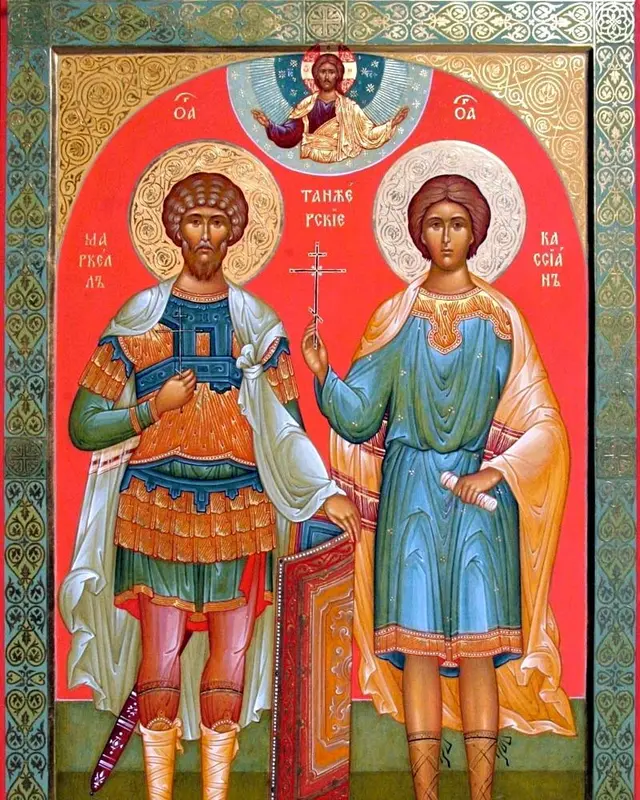
Saint Marcellus of Tangier
Centurion who threw down his arms at the emperor's birthday feast and was beheaded at Tangier
- Rank
- Saint
- Kind
- Martyr
- Life
- d. ~298
- Era
- 3rd century
- Feast
- 30 October
- Countries
- Morocco
Life story
Marcellus was a centurion in the Roman army. According to the Passion on which Alban Butler drew, at the feast for the birthday of Emperor Maximian, which included pagan sacrifices, he refused to take part. Before his company he took off his military belt, threw down his arms and the vine-branch that marked a centurion, and declared himself a soldier of Christ.
His comrades reported him to Anastasius Fortunatus, the prefect of the legion, who had him imprisoned. After the festivities Fortunatus questioned him, and Marcellus repeated his confession. Unable to overlook the matter, Fortunatus referred the case to the emperors, and Marcellus was sent under guard to Tangier, to Aurelian Agricolaus, vicar of the praetorian prefect. Agricolaus confirmed the facts, called the act desertion and impiety, and sentenced him to death. He was beheaded on 30 October 298.
The Passion is accompanied by a short account of Cassian, said to have been a court stenographer who refused to record the sentence and was also executed; this may be later legend. The Roman Martyrology records only that he was beheaded at Tangier under the vice-prefect Agricolaus. Tradition holds that his relics were moved to León in Spain, where he is regarded as patron of the city.
Works and witness
- Served as a centurion in the Roman army
- Refused to take part in sacrifices for Maximian's birthday
- Threw down his belt and arms, declaring himself a soldier of Christ
- Beheaded at Tangier on 30 October 298
Patron of
City of León (Spain)
Saints from the same country
References
- Alban Butler, Lives of the Fathers, Martyrs and Other Principal Saints, “St. Marcellus the Centurion” (EWTN library) – retelling of the Passio; read via search summary
- Roman Martyrology entry for 30 October (Tangier, beheaded under vice-prefect Agricolaus), and Catholic Encyclopedia “Tingis” (newadvent.org/cathen/14736a) – Marcellus 30 October, Cassian 3 December
- Wikipedia (English), “Marcellus of Tangier” – the later wife-and-twelve-sons legend, which is not used
Written by Anawim from documented history. Some details about ancient saints rest on tradition and are marked as such.