

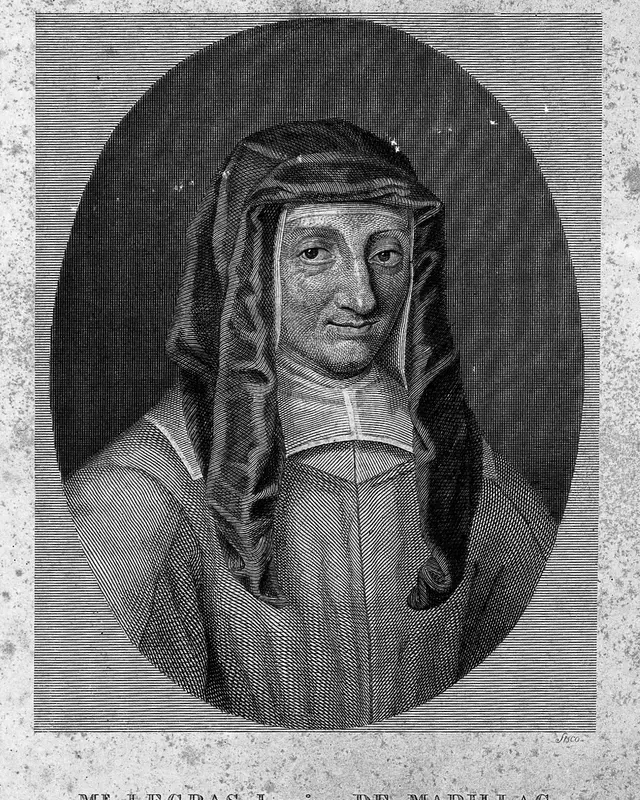
Saint Louise de Marillac
A Parisian widow who co-founded the Daughters of Charity with Vincent de Paul
- Rank
- Saint
- Kind
- Founder, Religious
- Life
- 1591 – 1660
- Era
- 17th century
- Feast
- 15 March
- Countries
- France
Life story
Louise de Marillac was born on 12 August 1591, most likely in Paris, the illegitimate daughter of Louis de Marillac, whose family was influential at the French court. She received a careful education and once considered religious life, but was not accepted because of her health. In 1613 she married Antoine Le Gras, an official in the household of Queen Marie de' Medici, and they had a son, Michel.
Her husband died in 1625 after a long illness. In the following years she met Vincent de Paul, who became her confessor and collaborator. Vincent had founded the Confraternities of Charity, groups of lay women who visited the sick poor in parishes, and he entrusted her with visiting and guiding these groups in many places around Paris.
From that experience she saw the need for women who could give all their time to this work. On 29 November 1633 she received the first young women into her house in Paris, a date regarded as the foundation of the Daughters of Charity. Unlike nuns of the time, the sisters were not enclosed but went to patients, abandoned children, prisoners and the poor, and she wrote their rules and trained them.
She died on 15 March 1660 in Paris, six months before Vincent de Paul. She was beatified in 1920 and canonised in 1934 by Pius XI. In 1960 Pope John XXIII declared her patron of social workers.
Works and witness
- Married in 1613 and widowed in 1625
- Worked with Vincent de Paul on the Confraternities of Charity
- Founded the Daughters of Charity on 29 November 1633
- Trained sisters to serve patients, foundlings and the poor
- Canonised in 1934
Patron of
Social workers
Saints from the same country
References
- Martyrologium Romanum
- Dicastery for the Causes of Saints – biographical profile
- Louise de Marillac, Écrits spirituels (letters and writings)
Written by Anawim from documented history. Some details about ancient saints rest on tradition and are marked as such.