

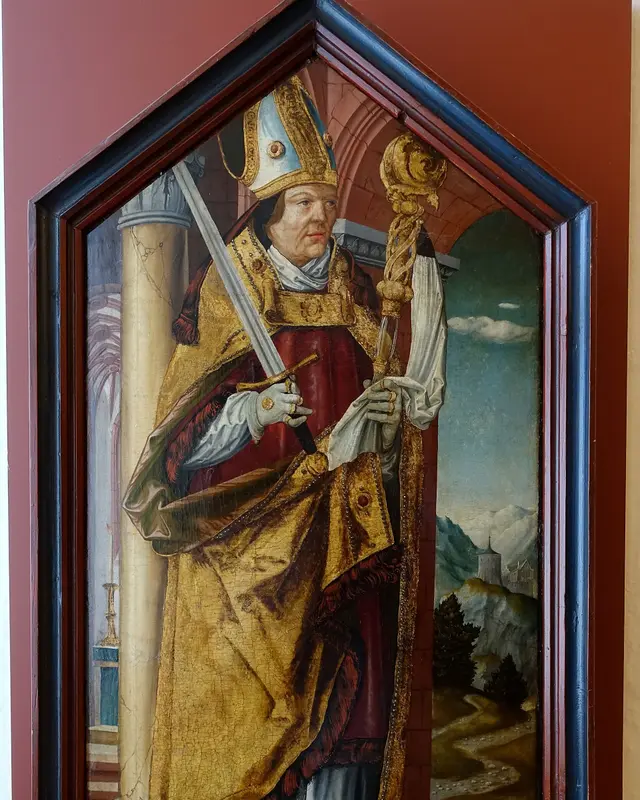
Saint Kilian
The Irish missionary bishop martyred at Würzburg, known as apostle of Franconia
- Rank
- Saint
- Kind
- Martyr, Missionary, Bishop
- Life
- 640 – 689
- Era
- 7th century
- Feast
- 8 July
- Countries
- Germany, Ireland
Life story
Kilian was born around 640, according to tradition at Mullagh in County Cavan, Ireland. He grew up in the monastic culture of Ireland and was ordained priest and then bishop. An old tradition says that he left Ireland with eleven companions for the continent, intending to preach in regions where many people had not yet embraced Christianity.
The group reached Franconia, in what is now Germany, and he made Würzburg his base, a place governed by a local duke. The biographical sources say his preaching had notable success, though the details of the story appear in fairly late texts. According to those texts, he travelled to Rome to seek the Pope's approval for the mission. After his return, he told the duke that his marriage was not valid, and this is given as the reason he was killed.
Kilian died at Würzburg in 689, killed together with two companions, traditionally the priest Colman and the deacon Totnan. His grave was kept by the local people, and veneration of him grew strongly in Würzburg, where the great cathedral bears his name. The Church remembers him on 8 July. He is honoured as the patron of Würzburg. The Würzburg sources that tell his story were written well after the events, so his life is known mainly through this local tradition. His cult spread from Würzburg across Franconia, and his feast is still observed in the city each July.
Works and witness
- Left Ireland for the continent with a group of companions
- Preached in Franconia from a base at Würzburg
- Killed in 689 together with two companions
- His relics are venerated at Würzburg
- Patron of the city of Würzburg
Patron of
City of Würzburg
Saints from the same country
References
- Martyrologium Romanum
- Passio Kiliani (early medieval)
- Dicastery for the Causes of Saints – biographical profile
Written by Anawim from documented history. Some details about ancient saints rest on tradition and are marked as such.