

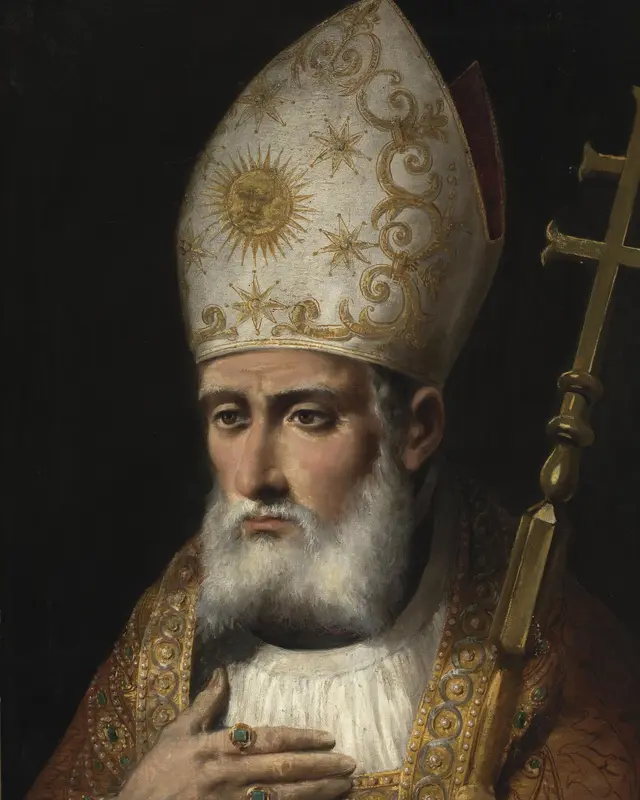
Saint John of Ribera
Archbishop of Valencia who founded the Corpus Christi College on Tridentine lines
- Rank
- Saint
- Kind
- Bishop
- Life
- 1532 – 1611
- Era
- 17th century
- Feast
- 6 January
- Countries
- Spain
Life story
Juan de Ribera was born on 20 March 1532 in Seville, Spain. His father was Pedro Afán de Ribera, viceroy of Naples and duke of Alcalá. He studied at the University of Salamanca and was ordained a priest in 1557.
On 27 May 1562 Pius IV appointed him bishop of Badajoz, at about the age of thirty. At the end of 1568 he was moved to Valencia as archbishop and took charge of the diocese in early 1569; he also held the title of patriarch of Antioch. He remained archbishop until his death, and in 1602 King Philip III also made him viceroy of Valencia.
His best-known foundation was the Royal College of Corpus Christi in Valencia (also called the College of St John), established to train priests in line with the Council of Trent. The Catholic Encyclopedia also credits him with promoting monastic reform, especially by bringing the Capuchins to Valencia.
On the expulsion of the Moriscos in 1609, the sources present him as a supporter of expulsion; historians assess his role in different ways. He died in Valencia on 6 January 1611. Pius VI beatified him on 18 September 1796, and John XXIII canonised him on 12 June 1960. His feast day is 6 January.
Works and witness
- Bishop of Badajoz from 1562, at about thirty
- Archbishop of Valencia from late 1568 until his death
- Founded the Royal College of Corpus Christi to train priests
- Made viceroy of Valencia by Philip III in 1602
- Beatified in 1796 and canonised on 12 June 1960
Saints from the same country
References
- Catholic-Hierarchy.org, “Archbishop St. Juan de Ribera”, catholic-hierarchy.org/bishop/bderibera.html
- Catholic Encyclopedia, “Valencia”, newadvent.org/cathen/15251b.htm
Written by Anawim from documented history. Some details about ancient saints rest on tradition and are marked as such.