

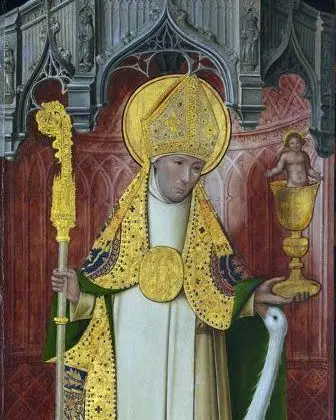
Saint Hugh of Lincoln
Carthusian monk turned bishop of Lincoln, defender of Church rights and of Lincoln's Jews
- Rank
- Saint
- Kind
- Bishop, Religious
- Life
- 1140 – 1200
- Era
- 12th century
- Feast
- 16 November
- Countries
- United Kingdom, France
Life story
Hugh was born around 1140 at Avalon, in what is now south-eastern France. He entered the Carthusian Order at the Grande Chartreuse in 1163, an order devoted to silence and solitude. Around 1179 King Henry II of England invited him to lead the Carthusian house at Witham in Somerset, which the king had founded as penance. He built the community up and became known for his fairness.
In 1186 he was elected bishop of Lincoln. Although on friendly terms with the king, he maintained the Church's independence from the crown and more than once resisted royal demands. At the beginning of Richard I's reign, when attacks on the Jewish communities broke out, he tried to protect the Jews of Lincoln. He also began the rebuilding of Lincoln Cathedral after the earthquake of 1185, though it was unfinished when he died.
Hugh died in London on 16 November 1200 and was buried at Lincoln. According to tradition a white swan was attached to him, and the bird became his emblem. Pope Honorius III canonised him in 1220. Catholics keep his feast on 16 November and the Church of England on 17 November. The biography by his chaplain Adam of Eynsham recounts that he refused a demand from Richard I for money for the king's wars, and that he kept speaking plainly to the crown under King John as well, even in his last months.
Works and witness
- Entered the Carthusians at the Grande Chartreuse in 1163
- Led the Carthusian house at Witham from about 1179
- Bishop of Lincoln from 1186
- Protected Lincoln's Jewish community during riots
- Canonised in 1220
Saints from the same country
References
- Martyrologium Romanum
- Magna Vita sancti Hugonis
- Dicastery for the Causes of Saints – biographical profile
Written by Anawim from documented history. Some details about ancient saints rest on tradition and are marked as such.