

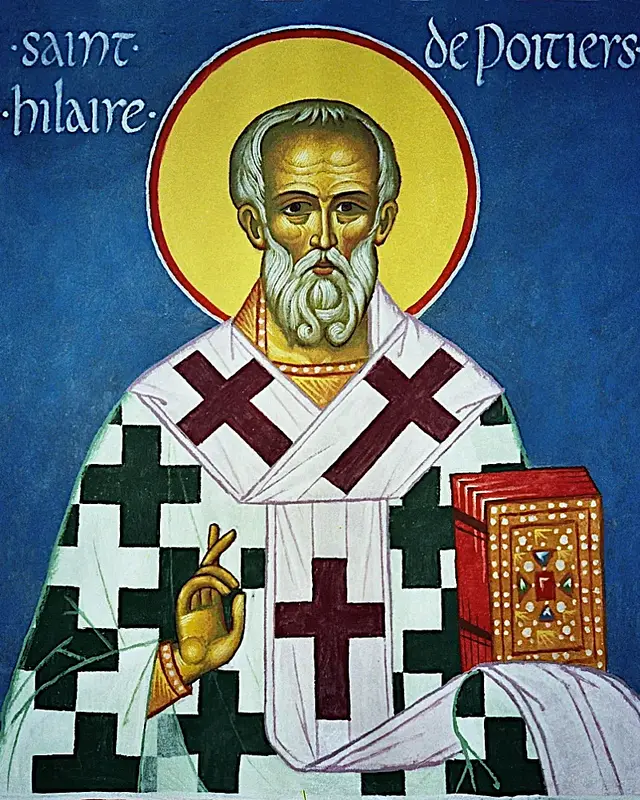
Saint Hilary of Poitiers
Bishop of Poitiers exiled for defending the faith of Nicaea
- Rank
- Saint
- Kind
- Bishop, Doctor of the Church
- Life
- ~310 – ~367
- Era
- 4th century
- Feast
- 13 January
- Countries
- France
Life story
Hilary was born around 310 in Poitiers, in Gaul, into an educated pagan family. He married and had a daughter, and he became a Christian as an adult after reading the Scriptures. Around 350 the people chose him as bishop of Poitiers. At that time the Church was divided by Arianism, the teaching that the Son is lesser than the Father, and the emperor Constantius II backed that party.
Hilary refused to sign the condemnation of Athanasius at the synod of Béziers in 356, and for this the emperor exiled him to Phrygia in Asia Minor. During those years he met Eastern Christian groups, studied Greek thought more deeply and wrote On the Trinity, a major Latin work on that doctrine. He also composed commentaries on the Gospel of Matthew and on the Psalms, and by tradition he was the first in the West to write hymns in Latin.
He returned to Poitiers around 360 and kept up the struggle for the Nicene faith in Gaul until his death in 367. At Poitiers, Martin, later bishop of Tours, came to him as a disciple and founded a monastery at nearby Ligugé. In 1851 Pope Pius IX declared Hilary a Doctor of the Church. The Church keeps his feast on 13 January. His work was influential for later Latin theology, and writers such as Augustine and Jerome knew and quoted his writings on the Trinity.
Works and witness
- Converted as a married adult and became bishop of Poitiers around 350
- Refused to condemn Athanasius and was exiled to Phrygia in 356
- Wrote On the Trinity and commentaries on Matthew and the Psalms
- By tradition, the first Latin hymn writer of the West
- Declared a Doctor of the Church in 1851
Saints from the same country
References
- Hilary of Poitiers, De Trinitate
- Sulpicius Severus, Vita Martini
- Martyrologium Romanum
Written by Anawim from documented history. Some details about ancient saints rest on tradition and are marked as such.