

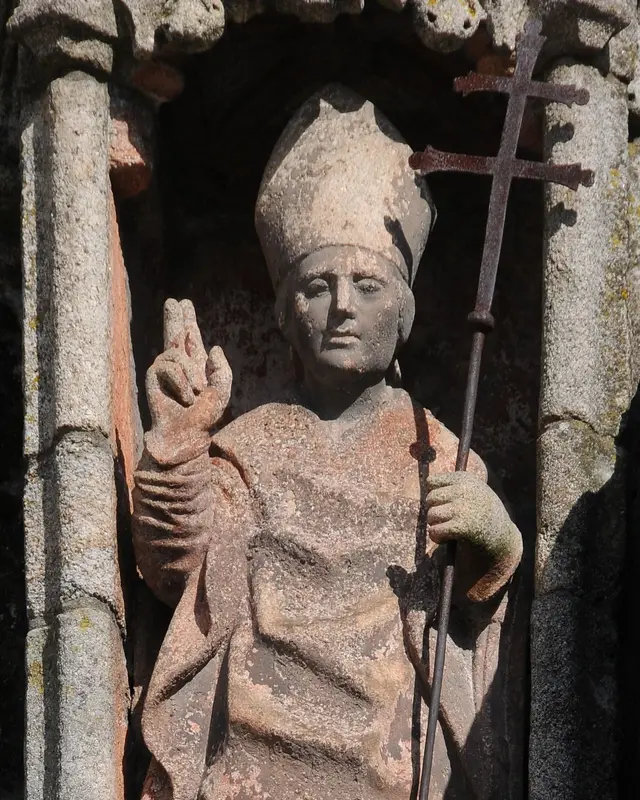
Saint Fructuosus of Braga
Visigothic-era hermit and monastic founder who became archbishop of Braga
- Rank
- Saint
- Kind
- Bishop, Religious
- Life
- d. 665
- Era
- 7th century
- Feast
- 16 April
- Countries
- Spain, Portugal
Life story
Fructuosus was born around 600 in the Visigothic kingdom. The sources say he was the son of a Visigothic general (dux) in the Bierzo region and that he studied at Palencia. After his parents died he lived as a hermit in a remote area of Galicia.
Disciples gathered around him, and from this came the monastery of Compludo (Complutum) in the Bierzo. He led it for a time, then appointed an abbot and withdrew again. He later founded nine more monasteries and a women's community of about eighty virgins under the abbess Benedicta. Two monastic rules under his name survive: one written for Compludo and a “common” rule for a union of monasteries under an abbot-bishop.
In 654 he was called to be bishop of Dumium, and on 1 December 656 he became archbishop of Braga. His life was recorded in an early Vita based on his disciples' accounts; scholars have debated its authorship.
He died on 16 April around 665. In 1102 his relics were moved to Compostela, and they later returned to Braga. He is usually shown with a stag, which tradition says he saved from hunters. The sources consulted do not describe a formal canonisation process; he is venerated as a saint and his feast day is 16 April.
Works and witness
- Founded the monastery of Compludo in the Bierzo and nine other monasteries
- Founded a women's community of about eighty virgins under the abbess Benedicta
- Wrote two monastic rules that survive
- Bishop of Dumium in 654; archbishop of Braga on 1 December 656
- His relics were moved to Compostela in 1102
Saints from the same country
References
- Catholic Encyclopedia, “St. Fructuosus of Braga”, newadvent.org/cathen/06311a.htm
- CatholicSaints.Info, “Saint Fructuosus of Braga”, catholicsaints.info/saint-fructuosus-of-braga/
Written by Anawim from documented history. Some details about ancient saints rest on tradition and are marked as such.