

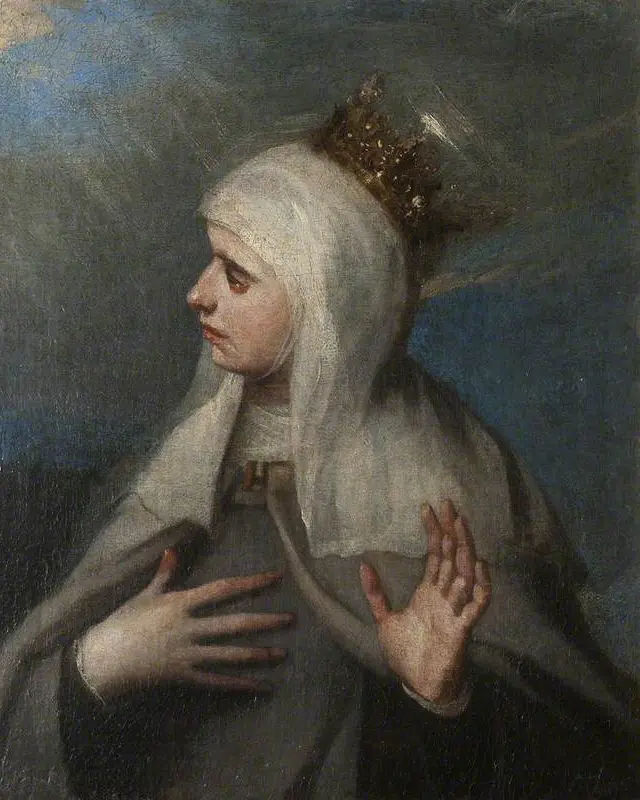
Saint Elizabeth of Portugal
A queen of Portugal remembered for making peace between kings and princes
- Rank
- Saint
- Kind
- Royalty, Layperson
- Life
- 1271 – 1336
- Era
- 14th century
- Feast
- 4 July
- Countries
- Portugal, Spain
Life story
Elizabeth was born in 1271 in Zaragoza, daughter of King Peter III of Aragon. She was named after a kinswoman, Elizabeth of Hungary, who was honoured for her charity. In 1288, still very young, she married King Denis of Portugal, who was both an active ruler and a poet. They had two children, Constance and Afonso, the future Afonso IV.
The marriage was not easy, as Denis had several illegitimate children, but Elizabeth kept her place as queen and looked after those children too. She founded hospitals, an orphanage and other charitable works for the poor, and built the convent of St Clare at Coimbra. She is chiefly remembered as a peacemaker: around 1322-1323, when Prince Afonso rose in arms against his father, she placed herself between them to prevent a battle, and she also mediated between the Iberian kingdoms.
After Denis died in 1325 she made a pilgrimage to Santiago de Compostela, then became a member of the Franciscan Third Order and lived near the convent of St Clare in Coimbra, personally caring for the sick and poor.
In 1336, despite her age and weakness, she set out for Estremoz to try to prevent war between her son Afonso IV and King Alfonso XI of Castile. She fell ill there and died on 4 July 1336. Her body was taken back for burial at Coimbra. Pope Urban VIII canonised her in 1625.
Works and witness
- Married King Denis of Portugal in 1288
- Founded hospitals and an orphanage and built the convent of St Clare at Coimbra
- Mediated between King Denis and Prince Afonso around 1322-1323
- As a widow joined the Franciscan Third Order and lived in Coimbra
- Died at Estremoz in 1336; canonised in 1625
Saints from the same country
References
- Martyrologium Romanum
- Dicastery for the Causes of Saints – biographical profile
- Lives of the Queens of Portugal (Portuguese royal chronicles)
Written by Anawim from documented history. Some details about ancient saints rest on tradition and are marked as such.