

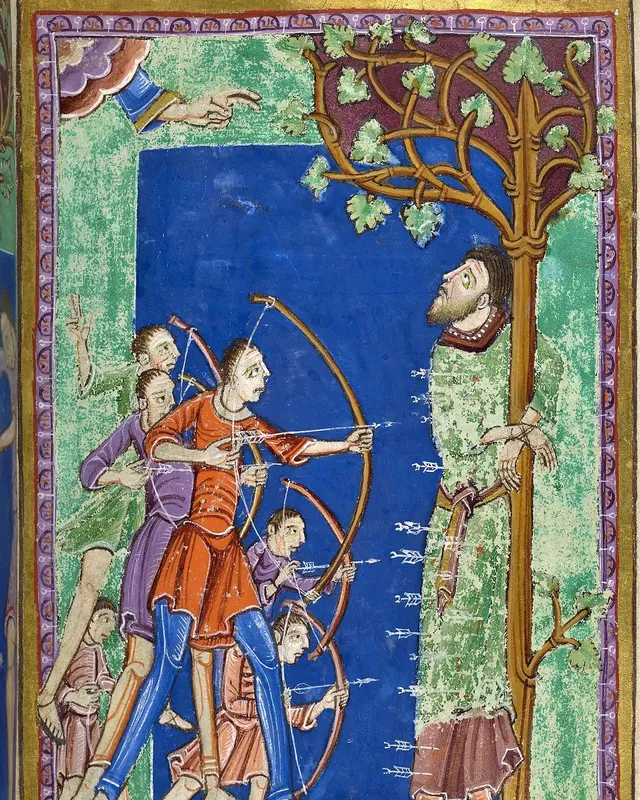
Saint Edmund the Martyr
East Anglian king killed by the Danes in 869 and venerated very early
- Rank
- Saint
- Kind
- Royalty, Martyr
- Life
- d. 869
- Era
- 9th century
- Feast
- 20 November
- Countries
- United Kingdom
Life story
Edmund was king of East Anglia from about 855 until 20 November 869. His accession date is uncertain: the twelfth-century Annals of St Neots give Christmas Day 855 and a crowning in 856, but no source for these statements is known, so they count as tradition. The year of death, 869, may also be 870, since the Anglo-Saxon Chronicle sometimes began its year in September.
The Great Heathen Army arrived in East Anglia in 865 and moved on to York in 866. The Anglo-Saxon Chronicle says only that the Danes took the victory and killed the king; it is unknown whether he fell in battle or was killed afterwards. The role of the leader Ivar is named only in Abbo of Fleury's Passio Sancti Eadmundi, written around 986, which historians such as Gransden consider largely hagiographical. The traditional site of his death is Hoxne in Suffolk, but the evidence allows only that he may have died there; Dernford and Bradfield St Clare have also been proposed.
His body was later moved to Beodricesworth, now Bury St Edmunds in the early tenth century (the Catholic Encyclopedia gives 903), and his shrine became the centre of a great abbey. Memorial pennies reading SCE EADMVND REX were minted from about 890 to 910, showing that he was venerated early. His feast is 20 November.
Works and witness
- King of East Anglia from about 855 (traditional date) to 869
- Killed by the Danish army on 20 November 869 (possibly 870)
- Venerated early, shown by memorial coins of about 890 to 910
- His body was moved to Bury St Edmunds, where his shrine became famous
Patron of
Diocese of East Anglia
Saints from the same country
References
- Catholic Encyclopedia, "St. Edmund the Martyr" (newadvent.org/cathen/05295a.htm)
- Britannica, "Edmund, king of East Anglia"
Written by Anawim from documented history. Some details about ancient saints rest on tradition and are marked as such.