

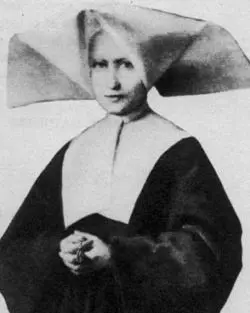
Saint Catherine Labouré
The Paris Sister of Charity whose reported visions led to the Miraculous Medal
- Rank
- Saint
- Kind
- Virgin, Mystic, Religious
- Life
- 1806 – 1876
- Era
- 19th century
- Feast
- 28 November
- Countries
- France
Life story
Catherine Labouré was born on 2 May 1806 in Fain-lès-Moutiers, in Burgundy, France, into a large farming family. Her mother died when she was small, and she grew up doing housework and farm work. After a period of waiting caused by her family's opposition, she was allowed to enter the Daughters of Charity and came to Paris in 1830.
At the order's novitiate on rue du Bac in Paris, she reported that in 1830 she had seen Mary three times, including in July and on 27 November. According to her account, she was told to have a medal struck. She spoke of this only to her confessor, Father Aladel, and the first medals were struck in 1832, when cholera was raging in Paris.
The medal spread quickly and became commonly known as the Miraculous Medal. Meanwhile Catherine was sent to work at the Enghien hospice for the elderly in Paris, where she cared for the old for forty-six years, doing laundry, cooking and tending the animals. She lived so quietly that the sisters of her community did not know she was the recipient of the visions until shortly before she died.
She died on 31 December 1876 in Paris. Her body rests in the chapel on rue du Bac. She was canonised by Pope Pius XII on 27 July 1947. The Church keeps her feast on 28 November. She was seventy years old.
Works and witness
- Entered the Daughters of Charity in Paris in 1830
- Reported visions of 1830 in the chapel on rue du Bac
- The first Miraculous Medals were struck in 1832
- Served the elderly at the Enghien hospice for forty-six years
- Died on 31 December 1876; canonised in 1947
Saints from the same country
References
- Martyrologium Romanum
- Dicastery for the Causes of Saints – biographical profile
- Vincentian Family Encyclopedia, entry Catherine Labouré
Written by Anawim from documented history. Some details about ancient saints rest on tradition and are marked as such.