

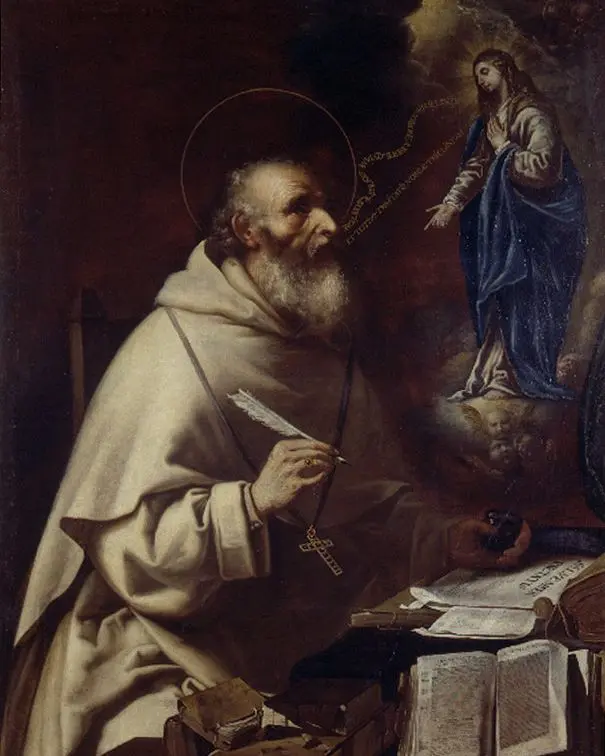
Saint Albert the Great
Teacher of Thomas Aquinas and a Dominican polymath of philosophy and natural science
- Rank
- Saint
- Kind
- Bishop, Doctor of the Church, Religious
- Life
- 1200 – 1280
- Era
- 13th century
- Feast
- 15 November
- Countries
- Germany
Life story
Albert was born around 1200 in Lauingen in Swabia, into a noble family. He studied at Padua, and around 1223 joined the Dominican Order, which had been founded only a few years earlier. He studied and taught theology in several Dominican houses in Germany, then went to Paris, where he took his master's degree in theology in 1245 and taught.
In 1248 he was sent to Cologne to set up a general house of study for the order, and Thomas Aquinas was among the students who followed him. Albert promoted reading and commenting on the works of Aristotle, along with the related Greek, Arabic and Jewish authors. He wrote extensively on logic, metaphysics, plants, animals, minerals and astronomy, drawing on observation as well as books, and was later called the Great and the Universal Doctor.
Beyond teaching, he took on duties in the order and the Church. In 1254 he was elected provincial of the German province. In 1260 the pope appointed him bishop of Regensburg, but he asked to resign after about two years in order to return to teaching. He also repeatedly acted as peacemaker in disputes, notably in the arbitration at Cologne in 1258, and attended the Council of Lyon in 1274.
His health failed in his last years. He died in Cologne on 15 November 1280 and was buried in the Dominican church there. In 1931 Pope Pius XI canonised him and declared him a Doctor of the Church in the same act. In 1941 Pope Pius XII named him patron of natural scientists.
Works and witness
- Joined the Dominicans around 1223 and became a master of theology at Paris in 1245
- Founded the order's house of study at Cologne in 1248 and taught Thomas Aquinas
- Wrote widely on Aristotle, botany, zoology, minerals and astronomy
- Provincial of Germany from 1254; bishop of Regensburg about 1260-1262
- Canonised and declared a Doctor of the Church in 1931
Patron of
Natural scientists
Saints from the same country
References
- Martyrologium Romanum
- Dicastery for the Causes of Saints – biographical profile
- Albertus Magnus, De vegetabilibus et plantis
Written by Anawim from documented history. Some details about ancient saints rest on tradition and are marked as such.