

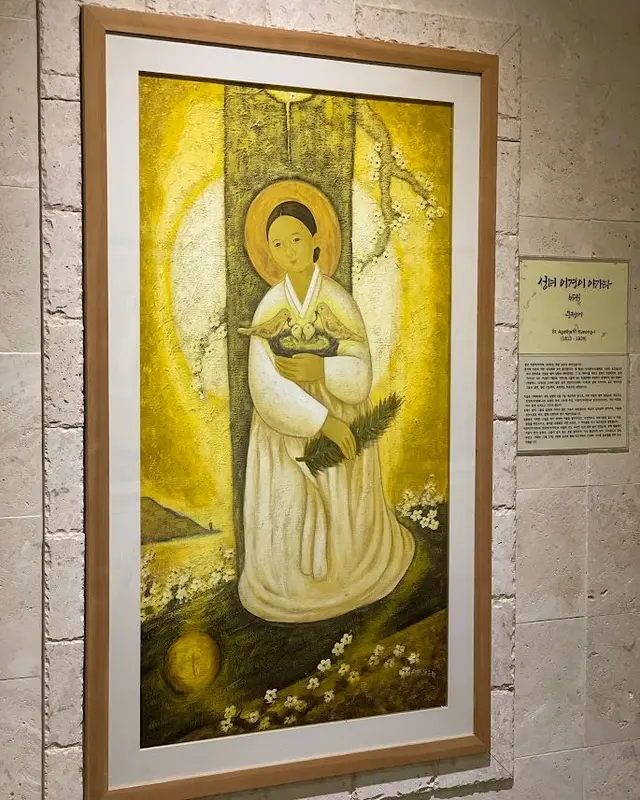
Saint Agatha Yi Kyong-i
Korean laywoman beheaded with Agatha Kwon at Danggogae on 31 January 1840
- Rank
- Saint
- Kind
- Martyr, Layperson, Virgin
- Life
- 1814 – 1840
- Era
- 19th century
- Feast
- 20 September
- Countries
- South Korea
Life story
Agatha Yi Kyong-i was born around 1814 into a Catholic family. The New Catholic Encyclopedia lists her as a virgin who died aged twenty-seven. Her mother was too poor to support her, so she went to live with Agatha Kwon Chin-i, and the two women remained close until the end of their lives.
During the Gihae persecution of 1839 to 1840 she was arrested together with Kwon and a servant girl, and placed under guard in Seoul. According to one account, sympathetic guards helped them escape; the servant girl was recaptured and revealed their hiding place, so all three were arrested again and the guards who had helped them were punished. The sources report that the two women were severely beaten but would not abandon their faith.
On 31 January 1840 she was beheaded at Danggogae, now in Seoul's Yongsan district, along with Agatha Kwon and other Catholics. Pope John Paul II canonized her in Seoul on 6 May 1984 among the 103 Korean martyrs. The group's shared feast is 20 September.
Works and witness
- Lived with Agatha Kwon Chin-i because her own mother was too poor
- Arrested in the Gihae persecution and held in Seoul
- Endured torture without renouncing her faith
- Beheaded at Danggogae, Seoul, on 31 January 1840
Saints from the same country
References
- Encyclopedia.com, “Korea, Martyrs of, Ss.” (New Catholic Encyclopedia) – Agatha Yi Kyong-i: virgin, died 31 January 1840, age 27, beheaded at Danggogae; 103 martyrs canonized 6 May 1984
- Catholic Bishops' Conference of Korea, “103 Korean Martyr Saints” and Catholic Online – living with Kwon Chin-i, escape and recapture (read through the Wikipedia article that cites them)
- A different Agatha Yi (1824–1840, strangled 9 January 1840, aged 17) must not be confused with her
Written by Anawim from documented history. Some details about ancient saints rest on tradition and are marked as such.