

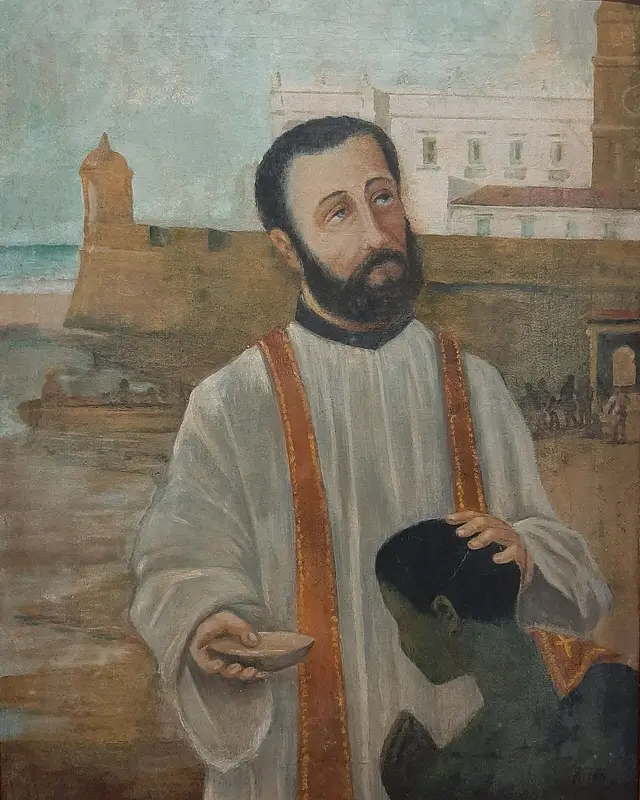
Saint Peter Claver
A Jesuit priest who served enslaved Africans in the port of Cartagena.
- Rank
- Saint
- Kind
- Priest, Missionary, Religious
- Life
- 1580 – 1654
- Era
- 17th century
- Feast
- 9 September
- Countries
- Spain, Colombia
Life story
Peter Claver was born around 1580 at Verdú in Catalonia, Spain, into a farming family. He studied in Barcelona and entered the Jesuits in 1602. On Mallorca he met the lay brother Alphonsus Rodriguez, who, according to biographers, encouraged him to become a missionary in the New World. After his studies on Mallorca he was sent to the Americas.
In 1610 he arrived at Cartagena de Indias, in New Granada (now Colombia), one of the main ports of the transatlantic slave trade. He was ordained a priest there in 1616. In 1622, at his final profession, he added a vow to be a servant of Black people for ever.
Whenever a slave ship docked, he went down with interpreters, bringing food, water and medicine to people who had just endured a brutal voyage. He taught and baptised many of them, and later visited them on plantations, in hospitals and in prisons. He had no power to end slavery, but he opposed the cruel treatment of those in his care. Biographers estimate that he baptised tens of thousands of people over the decades, though exact numbers cannot be verified.
In 1650 he fell ill during an epidemic and afterwards could scarcely move about. He died on 8 September 1654. He was canonised in 1888, and in 1896 Leo XIII named him patron of missions among Black people. His tomb is in the Jesuit church of Saint Peter Claver in Cartagena.
Works and witness
- Arrived in Cartagena in 1610 and was ordained priest in 1616.
- Met slave ships to bring food, water and medicine.
- Taught and baptised many Africans.
- Was canonised in 1888.
Patron of
Missions among Black people
Saints from the same country
References
- Martyrologium Romanum
- Dicastery for the Causes of Saints – biographical profile
- Alonso de Sandoval, De instauranda Aethiopum salute
Written by Anawim from documented history. Some details about ancient saints rest on tradition and are marked as such.