

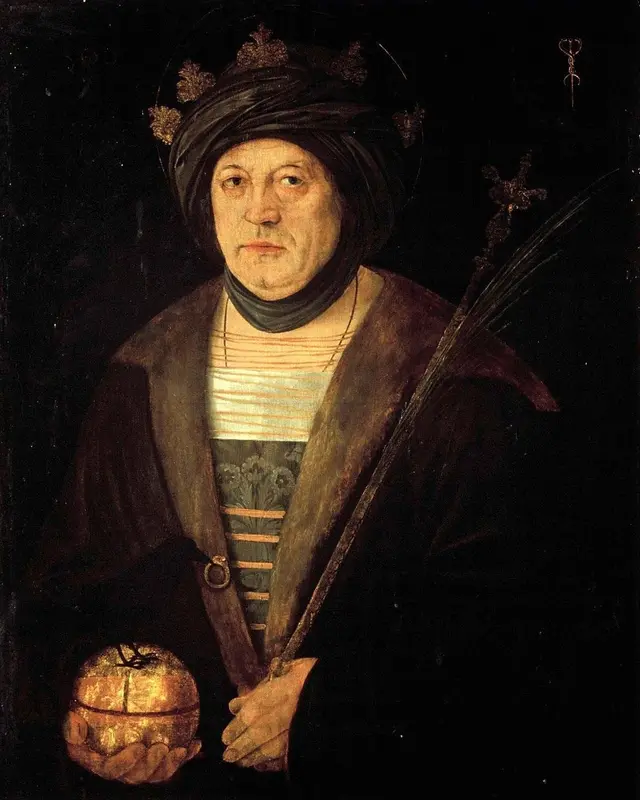
Saint Oswald of Northumbria
The Northumbrian king who won at Heavenfield and invited Aidan to preach
- Rank
- Saint
- Kind
- Royalty, Martyr
- Life
- 604 – 642
- Era
- 7th century
- Feast
- 5 August
- Countries
- United Kingdom
Life story
Oswald was born around 604 into the Northumbrian royal house. After his father, King Æthelfrith, was killed, he spent years in exile in Dál Riata and on Iona, where he met the Christianity of the Irish monks. On his return he had to face Cadwallon, king of Gwynedd, who had been ravaging Northumbria.
In 634 Oswald defeated Cadwallon at the battle of Heavenfield, near Hexham. According to Bede, before the fight he had a wooden cross put up and called on his soldiers to pray. After the victory he united the two kingdoms of Bernicia and Deira. He asked Iona to send a missionary, and Aidan was sent. Oswald gave him the island of Lindisfarne as his see, and on occasion acted as interpreter when Aidan preached to the people. Bede also records his widespread reputation for generosity to the poor.
Oswald was killed on 5 August 642 at the battle of Maserfield, fighting Penda of Mercia, a pagan king. Some sources give the year as 641. His body was dismembered and his relics were taken to several places: his head was buried at Lindisfarne and finally at Durham with Cuthbert, while his bones went to Bardney and then to Gloucester in 909. Veneration of him spread across the Anglo-Saxon world and the continent. The Church keeps his feast on 5 August. Bede remarks that he remained generous to travellers and the poor, and reports that miracles were told of the place where he fell. His cult spread to Germany, Switzerland and Scandinavia, where churches were dedicated to him in the Middle Ages.
Works and witness
- Spent his exile on Iona and became a Christian there
- Defeated Cadwallon at Heavenfield in 634
- United the kingdoms of Bernicia and Deira
- Invited Aidan to Northumbria and supported the mission
- Killed at Maserfield in 642 fighting Penda
Saints from the same country
References
- Bede, Historia ecclesiastica gentis Anglorum
- Martyrologium Romanum
- Adomnán, Vita Columbae
Written by Anawim from documented history. Some details about ancient saints rest on tradition and are marked as such.