

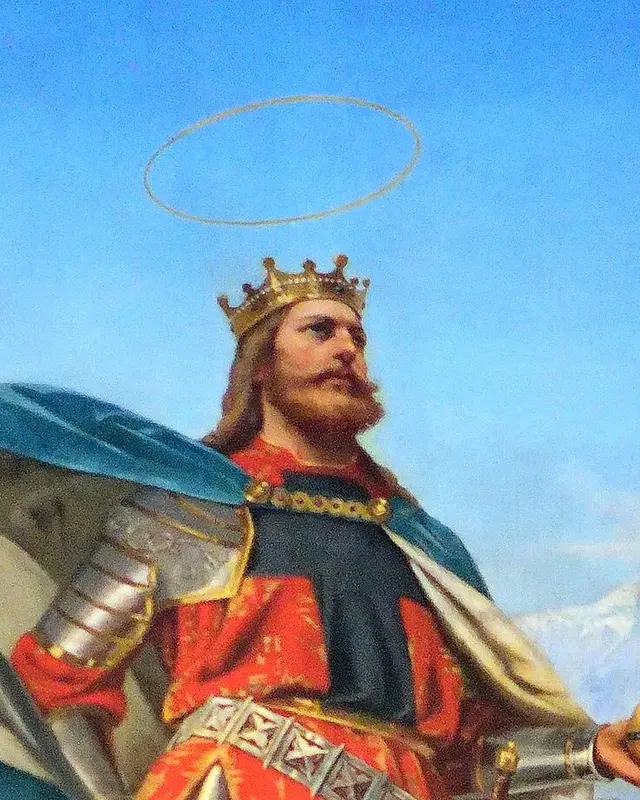
Saint Olaf of Norway
King of Norway who brought the realm into Christianity and fell at Stiklestad in 1030
- Rank
- Saint
- Kind
- Royalty, Martyr
- Life
- 995 – 1030
- Era
- 11th century
- Feast
- 29 July
- Countries
- Norway
Life story
Olaf Haraldsson was born around 995 into a family with royal claims in Norway. In his youth he took part in Viking expeditions to the coasts of Europe, including England and Normandy. According to medieval sources he was baptised at Rouen around 1013–14. In 1015 he returned to Norway, defeated his rivals and was acclaimed king. The sagas written in Iceland in the following centuries, especially those of Snorri Sturluson, supply many of the details of his early career, though they were composed long after his death.
As king, Olaf wanted to unify the country and make Christianity the religion of the whole realm. He brought in bishops and priests from England, issued church laws, and used royal power to enforce abandoning the old beliefs, sometimes harshly enough to anger many local chieftains. That discontent, together with the efforts of King Cnut of Denmark and England to take Norway, drove Olaf from the throne around 1028–29. He fled east to the lands of Kyiv, where the ruler Yaroslav received him.
In 1030 Olaf returned to Norway with a small army to reclaim his kingdom. On 29 July he was defeated and killed at the battle of Stiklestad. Soon afterwards reports of miracles at his grave began to spread, and in 1031 Bishop Grimkell declared him a saint according to local custom. His body was buried at Nidaros, now Trondheim, where the great cathedral of the region was later built. Olaf became a central figure in Norwegian national memory and was called the eternal king of the country. Pilgrims came to his shrine from across northern Europe, and churches dedicated to him can be found in Scandinavia, the British Isles and the Baltic lands.
Works and witness
- King of Norway from 1015; baptised at Rouen around 1013–14
- Brought English bishops and priests to build up the Church in Norway
- Overthrown around 1028–29 and exiled to the lands of Kyiv
- Killed at Stiklestad on 29 July 1030
- Proclaimed a saint locally in 1031 (formally canonised 1164); buried at Nidaros (Trondheim)
Patron of
Norway
References
- Snorri Sturluson, Heimskringla (Saga of Saint Olaf)
- Martyrologium Romanum
- Dicastery for the Causes of Saints – biographical profile
Written by Anawim from documented history. Some details about ancient saints rest on tradition and are marked as such.