

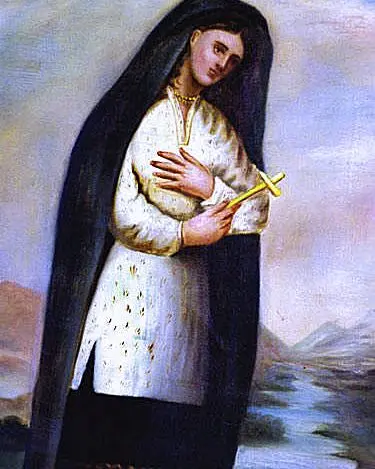
Saint Kateri Tekakwitha
A young Mohawk woman who became Christian, the first Native North American saint.
- Rank
- Saint
- Kind
- Layperson, Virgin
- Life
- 1656 – 1680
- Era
- 17th century
- Feast
- 14 July
- Countries
- United States, Canada
Life story
Tekakwitha was born in 1656 at Ossernenon on the Mohawk River, in present-day New York State. Her father was Mohawk, her mother a Christian Algonquin who had been captured and brought to the village. Around 1660 a smallpox epidemic killed her parents and her younger brother. She was left with a scarred face and weak eyesight, and was raised by an uncle. She grew up in her uncle's longhouse, among the Mohawk family and customs of her people.
In 1676 she was baptised at Easter by the Jesuit Jacques de Lamberville and took the name Catherine (Kateri). Her family and many in the village opposed her conversion, so in 1677 she fled north to Kahnawake near Montreal, where there was a community of Catholic Native people. The Jesuits who knew her at Kahnawake described her as gentle and devout.
There she lived a life of prayer and cared for the sick and elderly, and in 1679, on the feast of the Annunciation, she made a vow of virginity. Her health declined and she died on 17 April 1680, aged about twenty-four. The accounts written by the Jesuits who lived close to her are the main source for her life. She was buried at Kahnawake, where the mission church of Saint Francis Xavier still stands.
John Paul II beatified her in 1980 and Benedict XVI canonised her on 21 October 2012, making her the first Native North American saint.
Works and witness
- Survived the smallpox epidemic of about 1660 after losing her family.
- Was baptised in 1676.
- Left for Kahnawake in 1677 to practise her faith.
- Was canonised in 2012.
Saints from the same country
References
- Martyrologium Romanum
- Dicastery for the Causes of Saints – biographical profile
- Pierre Cholenec, Vie de Catherine Tegakouita (1696)
Written by Anawim from documented history. Some details about ancient saints rest on tradition and are marked as such.