

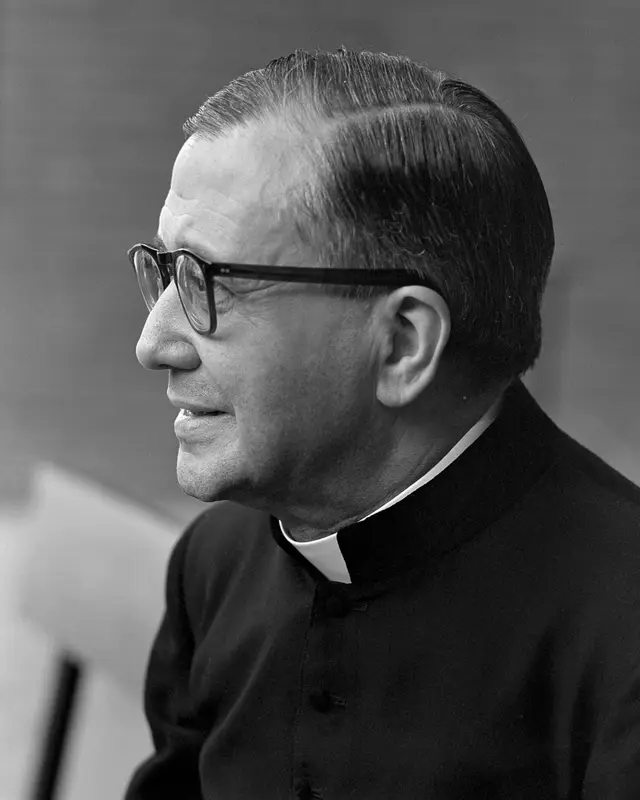
Saint Josemaría Escrivá
The Spanish priest who founded Opus Dei in 1928
- Rank
- Saint
- Kind
- Priest, Founder
- Life
- 1902 – 1975
- Era
- 20th century
- Feast
- 26 June
- Countries
- Spain, Italy
Life story
Josemaría Escrivá de Balaguer was born on 9 January 1902 at Barbastro, in Aragon, Spain. His family were merchants, and after his father's business failed they moved to Logroño. He entered the seminary at Logroño and then studied at Zaragoza, and was ordained priest on 28 March 1925.
After ordination he served in a rural parish, then went to Madrid, where he studied civil law and worked among the poor and among students. On 2 October 1928 he said he had recognised his mission to found Opus Dei, an organisation meant to help lay people live their faith through their work and daily life. In 1934 he published the book of reflections Camino (The Way).
During the Spanish Civil War (1936-1939) he hid for a time to avoid arrest as a priest, then crossed the Pyrenees into Andorra and made his way back to Burgos. From 1946 he lived mainly in Rome, where he placed the headquarters of Opus Dei. In 1943 he had also founded the Priestly Society of the Holy Cross.
He died on 26 June 1975 in Rome. Opus Dei was established by the Holy See as a personal prelature in 1982. John Paul II beatified him on 17 May 1992 and canonised him on 6 October 2002. Over the following decades Opus Dei spread to many countries, its members being mostly lay men and women in ordinary professions. Escrivá is buried in the prelatic church of Our Lady of Peace in Rome, and his writings, including The Way and Furrow, are widely read in many languages.
Works and witness
- Ordained in 1925, pastoral work in Madrid from 1927
- Founded Opus Dei on 2 October 1928
- Published Camino in 1934
- Lived in Rome from 1946 and directed Opus Dei from there
Saints from the same country
References
- Martyrologium Romanum
- Dicastery for the Causes of Saints – biographical profile
- Josemaría Escrivá, Camino
Written by Anawim from documented history. Some details about ancient saints rest on tradition and are marked as such.