

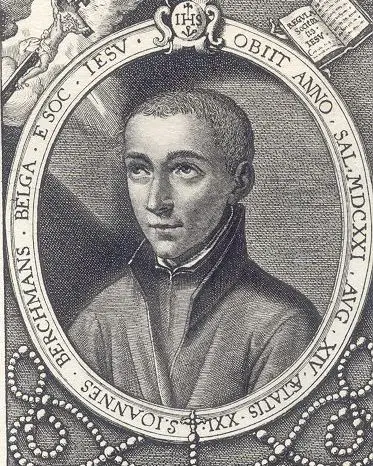
Saint John Berchmans
A Belgian Jesuit scholastic who died in Rome at twenty-two
- Rank
- Saint
- Kind
- Young saint, Religious
- Life
- 1599 – 1621
- Era
- 17th century
- Feast
- 26 November
- Countries
- Belgium, Italy
Life story
John was born on 13 March 1599 at Diest, in what is now Belgium, into a shoemaker's family. From childhood he was known for diligence in study and for piety. He served the church as an altar boy, and was taken on as a servant in a priest's household at Mechelen so that he could study at the Jesuit school.
On 24 September 1616 he entered the Jesuit novitiate and took his first vows on 24 January 1618. His superiors sent him to Rome to study philosophy at the Roman College. According to his contemporaries he did nothing extraordinary, but was known for keeping faithfully to the small duties of a student's daily routine. He took part in public philosophical disputations at the college.
In August 1621 he fell ill with fever and dysentery and died on 13 August 1621 in Rome at twenty-two. He is buried in the church of Sant'Ignazio, where people still come to visit. He was beatified in 1865 and canonised on 15 January 1888 under Leo XIII. His feast is now 26 November; before 1969 it was 13 August. His life was short and uneventful by the standards of most saints, and his cult grew mainly from the reputation he left among fellow students and teachers. He is often shown in art holding a crucifix, a rule book and a rosary. A healing at a convent school in Louisiana in 1866 was accepted in the process that led to his canonisation.
Works and witness
- Studied at Mechelen and served the church as an altar boy
- Entered the Jesuit novitiate on 24 September 1616
- Studied philosophy at the Roman College in Rome
- Died on 13 August 1621 at the age of 22
- Canonised in 1888
Patron of
Altar servers, Students
Saints from the same country
References
- Martyrologium Romanum
- Catholic Encyclopedia (1907–1912), entry on John Berchmans
- Dicastery for the Causes of Saints – biographical profile
Written by Anawim from documented history. Some details about ancient saints rest on tradition and are marked as such.