

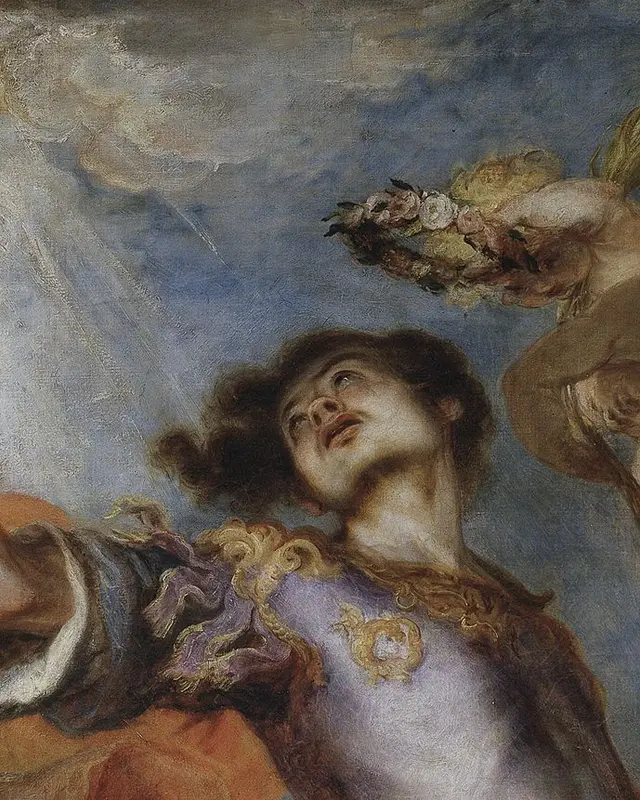
Saint Hermenegild
A Visigothic prince who turned Catholic and was executed in 585 after revolt
- Rank
- Saint
- Kind
- Martyr, Royalty
- Life
- 564 – 585
- Era
- 6th century
- Feast
- 13 April
- Countries
- Spain
Life story
Hermenegild was born around 564, the elder son of the Visigothic king Leovigild, who followed Arianism. In 579 he married Ingund, a Catholic Frankish princess. He was given charge of the region around Seville and there came under the influence of his wife and Bishop Leander, and turned to Catholicism.
Not long after, he rebelled against his father, at first with Byzantine support, but Leovigild bought the Byzantines off. After a siege Seville fell around 584, and Hermenegild was taken prisoner, held according to sources at Tarragona. Historians still debate whether the revolt was religious or political, since both elements were certainly present.
According to Gregory the Great, he was questioned and pressed to return to Arianism. When he refused to receive communion from an Arian bishop sent by his father, he was put to death in prison, traditionally beheaded on Easter night in 585, though some sources give 586. The place of death is sometimes given as Tarragona and sometimes as Seville.
Gregory the Great presented him as a martyr, but even at the time not everyone accepted that image. His brother Reccared, later king, turned to Catholicism in 587 or 589. Pope Sixtus V allowed his feast to be celebrated throughout Spain in 1585. His day of remembrance is 13 April. Some historians note that the Visigothic church was only fully united under Catholicism after Reccared, and that Hermenegild's story was taken up by later writers partly to explain that turning point.
Works and witness
- Elder son of King Leovigild, governed the region of Seville
- Married Princess Ingund in 579 and became Catholic
- Rebelled against his father and was captured around 584
- Executed in 585, traditionally at Easter
- His feast was extended to all Spain by Pope Sixtus V in 1585
Saints from the same country
References
- Gregory the Great, Dialogues, Book III
- Gregory of Tours, Historia Francorum
- Martyrologium Romanum
Written by Anawim from documented history. Some details about ancient saints rest on tradition and are marked as such.